
The ZK Proof Landscape in 2026
Zero-knowledge proofs have moved from theoretical cryptography to production-grade infrastructure. In 2026, the focus is no longer just on mathematical possibility but on solving the blockchain scalability trilemma through ZK-rollups that handle high throughput without sacrificing security.
The ecosystem is now defined by two dominant families: SNARKs (Succinct Non-interactive Arguments of Knowledge) and STARKs (Scalable Transparent Arguments of Knowledge). SNARKs offer smaller proof sizes and faster verification, making them ideal for storage-constrained environments. STARKs provide quantum resistance and do not rely on trusted setups, addressing long-term security concerns.
This shift has enabled ZK-rollups to process thousands of transactions off-chain while settling the final state on Ethereum. The result is a layer of infrastructure that scales linearly with demand, allowing applications to operate at consumer-grade speeds.
The choice between SNARKs and STARKs depends on the specific use case. Applications prioritizing minimal gas costs and fast finality often lean toward SNARKs. Projects requiring long-term security against quantum threats or transparent setup processes prefer STARKs. Both technologies are now mature enough for mainnet deployment, marking a definitive end to the experimental phase of zero-knowledge cryptography.
Snarks vs starks: core choices that change the plan
Choosing between ZK-SNARKs and ZK-STARKs comes down to a fundamental tension between efficiency and security assumptions. While both protocols enable zero-knowledge proofs, they rely on different cryptographic primitives that lead to distinct performance characteristics and risk profiles.
ZK-SNARKs (Succinct Non-Interactive Arguments of Knowledge) are currently the industry standard for high-throughput applications. They produce very small proofs that verify quickly, making them ideal for layer-2 scaling solutions where block space is expensive. However, this efficiency comes at the cost of relying on elliptic curve cryptography, which is theoretically vulnerable to future quantum computers. Additionally, SNARKs require a "trusted setup" ceremony, a one-time event where cryptographic parameters are generated. If the secret randomness used during this setup is not properly destroyed, it could allow an attacker to forge proofs.
ZK-STARKs (Scalable Transparent Arguments of Knowledge) address these vulnerabilities. They do not require a trusted setup, relying instead on transparent public randomness. More importantly, STARKs are quantum-resistant because they rely on hash functions rather than elliptic curves, which are considered more robust against quantum attacks. The tradeoff is size: STARK proofs are significantly larger than SNARK proofs, which can increase data storage and transmission costs. Verification speed is also generally slower, though this gap is narrowing with algorithmic improvements.
The following table compares the core technical attributes of both protocols to help determine the best fit for your specific use case.
| Attribute | ZK-SNARK | ZK-STARK |
|---|---|---|
| Proof Size | Small (KB range) | Large (MB range) |
| Verification Speed | Fast | Slower |
| Trusted Setup | Required | Not Required |
| Quantum Resistance | No (Elliptic Curves) | Yes (Hash Functions) |
| Transparency | Requires Trusted Setup | Fully Transparent |
For applications prioritizing minimal data footprint and fast verification, such as consumer-facing mobile wallets or high-frequency trading layers, ZK-SNARKs remain the pragmatic choice. However, for long-term infrastructure where quantum security and trustless initialization are non-negotiable, ZK-STARKs offer a more future-proof foundation. As hardware accelerates, the verification cost of STARKs is expected to decrease, potentially shifting the balance in their favor.
ZK-rollups driving mainstream adoption
ZK-rollups represent the most practical application of zero-knowledge proofs for scaling Ethereum today. By processing transactions off-chain and submitting a single validity proof on-chain, they achieve massive throughput increases without sacrificing the security guarantees of the base layer. This architecture allows thousands of transactions to be bundled and verified in seconds, reducing gas fees by orders of magnitude compared to legacy Layer 1 execution.
The mechanism works through a clear division of labor. The rollup operator executes the transactions and generates a cryptographic proof that all computations were correct. Ethereum validators then verify this compact proof rather than re-executing every individual transaction. This shift from computational verification to proof verification is what enables the scalability leap. As noted by Ethereum.org, this approach proves the validity of a statement without revealing the underlying data itself, preserving privacy while ensuring integrity [[src-serp-4]].
Institutional adoption is accelerating as these technical advantages translate into real-world utility. Financial institutions are increasingly exploring ZK-rollups to keep trading flows and customer data private while maintaining regulatory compliance [[src-serp-5]]. The ability to prove solvency or transaction validity without exposing sensitive business logic creates a compelling use case for enterprise-grade blockchain applications.
The infrastructure supporting ZK-rollups continues to mature, with major protocols like zkSync, StarkNet, and Scroll leading the charge. These networks demonstrate that zero-knowledge technology is no longer just theoretical but a functional scaling solution capable of handling real user demand. As proof generation becomes faster and cheaper, the gap between Layer 2 and Layer 1 user experience will continue to narrow, making ZK-rollups the preferred choice for high-frequency applications.
Privacy Beyond Simple Payments
Zero-knowledge proofs are moving past their initial role as tools for anonymous transactions. The technology is now enabling institutions to verify facts without exposing the underlying data, a shift that separates compliant privacy from the stigma often associated with privacy coins.
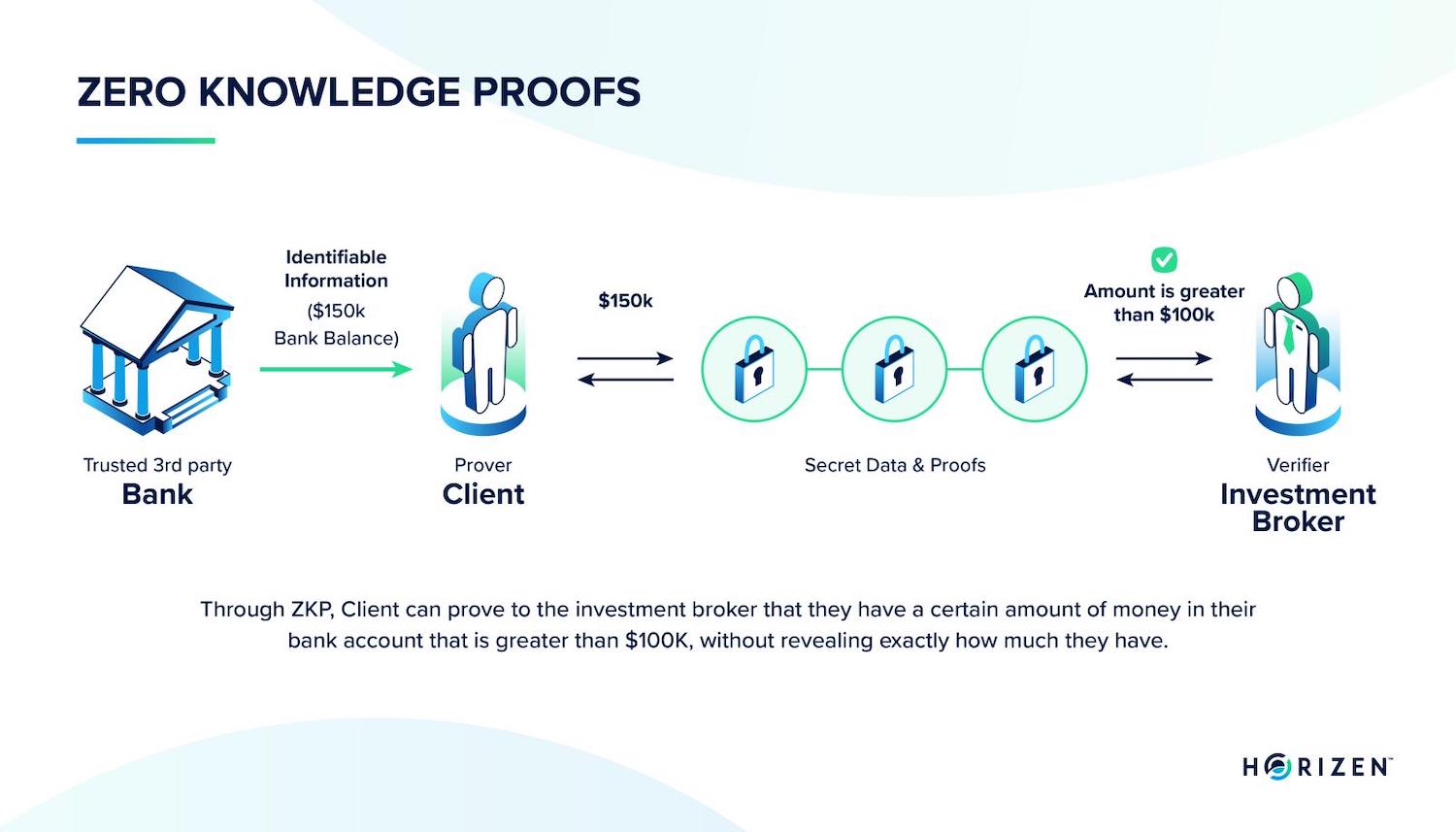
In decentralized identity, ZKPs allow users to prove attributes like age, citizenship, or creditworthiness without revealing their full identity. This is critical for institutional finance, where Know Your Customer (KYC) regulations are strict. A user can generate a proof that they are over 18 or reside in a specific jurisdiction without sharing their passport number or birth date. This reduces the attack surface for data breaches while maintaining regulatory compliance.
Institutional finance uses ZKPs to protect trading strategies and liquidity pools. A hedge fund can prove it has sufficient collateral for a loan or that a trade was executed at the correct price without revealing its position size or strategy to the public ledger. This allows for confidential order matching and private lending, solving the "front-running" problem inherent in transparent blockchains.
By decoupling verification from disclosure, ZKPs create a new layer of trust. Institutions can audit the validity of transactions without seeing the content, enabling a financial infrastructure that is both private and accountable.
Standardization and Future Roadmaps
Zero-knowledge proofs are moving from experimental cryptography to foundational infrastructure, but widespread adoption in high-stakes financial systems requires rigorous standardization. The ZKProof initiative, an open-industry academic effort, is currently leading the charge to mainstream ZKP cryptography through community-driven protocols. Their goal is to ensure that proofs generated by different providers are interoperable, verifiable, and secure across diverse blockchain environments.
For financial institutions, the lack of a unified standard is a significant barrier. Without clear guidelines, integrating ZK technology into existing compliance frameworks becomes risky and costly. The ZKProof workshop series, with its 8th iteration scheduled for May 2026 in Rome, serves as a critical forum for researchers and industry leaders to align on these technical requirements. These efforts are essential for creating the trust layer needed for institutional capital to flow into ZK-enabled applications.
The roadmap for 2026 and beyond focuses on finalizing these standards to support complex, high-throughput transactions. As the technology matures, the emphasis shifts from proving correctness to proving compliance with financial regulations. This transition is critical for moving beyond niche use cases into mainstream banking and asset management, where security and standardization are non-negotiable.
No comments yet. Be the first to share your thoughts!