
The 2026 compliance landscape for ZKPs
Zero-knowledge proofs have moved from theoretical cryptography to mandatory infrastructure for regulated finance. In 2026, the tension between user privacy and regulatory requirements like AML/KYC is no longer a debate; it is a technical constraint. Institutions can no longer choose between compliance and privacy. They must implement proofs that verify identity and transaction legitimacy without exposing underlying personal data or trading flows.
This shift is driven by the reality that traditional compliance methods require data transparency, which conflicts with Web3’s core value proposition. ZKPs allow institutions to keep trading flows private while proving compliance to regulators. This capability is essential for mass adoption, as it satisfies legal obligations without sacrificing user sovereignty.
The following comparison outlines how different ZK applications balance privacy preservation with regulatory scrutiny.
| Use Case | Privacy Level | Regulatory Compliance | Primary Use |
|---|---|---|---|
| ZK-Rollups | High | Indirect (via sequencer) | Scalability |
| ZK-Identity | Selective | Direct (KYC/AML) | Access Control |
| ZK-Proofs (General) | Maximum | Off-chain verification | Data Integrity |
The distinction between these use cases is critical. ZK-Rollups primarily offer scalability, with privacy being a secondary benefit derived from transaction batching. ZK-Identity, however, is designed specifically for compliance, allowing users to prove they meet KYC/AML requirements without revealing their full identity. General ZK-Proofs offer maximum privacy but require off-chain verification mechanisms, which can complicate regulatory audits.
As regulatory frameworks evolve, the ability to selectively disclose information will become the standard. This approach ensures that users retain control over their data while institutions meet their legal obligations. The future of Web3 compliance lies in this selective disclosure model, where privacy and regulation coexist through cryptographic proof rather than data exposure.
ZK-SNARKs vs ZK-STARKs: A technical comparison
Selecting between ZK-SNARKs and ZK-STARKs requires balancing proof efficiency against cryptographic assumptions. While both systems enable zero-knowledge proofs, their underlying mathematical structures dictate different trade-offs in scalability, security, and deployment complexity.
ZK-SNARKs (Succinct Non-Interactive Arguments of Knowledge) are currently the dominant standard in blockchain infrastructure, particularly for Ethereum Layer 2 rollups. Their primary advantage lies in succinctness: proofs are small (typically under 200 kilobytes) and verification is extremely fast, requiring minimal computational resources. However, this efficiency relies on a Trusted Setup ceremony. This initial phase involves generating cryptographic parameters that, if compromised, could allow an attacker to forge proofs. The community mitigates this risk through multi-party computation ceremonies, but the trust assumption remains a regulatory and security consideration.
ZK-STARKs (Scalable Transparent Arguments of Knowledge) eliminate the need for a Trusted Setup by relying on collision-resistant hash functions rather than elliptic-curve pairings. This makes them quantum-resistant and fully transparent. The trade-off is scale: STARK proofs are significantly larger (often megabytes in size) and verification is more computationally intensive. This increased overhead can impact transaction throughput and gas costs, making STARKs less suitable for networks with strict block size limits unless optimized further.
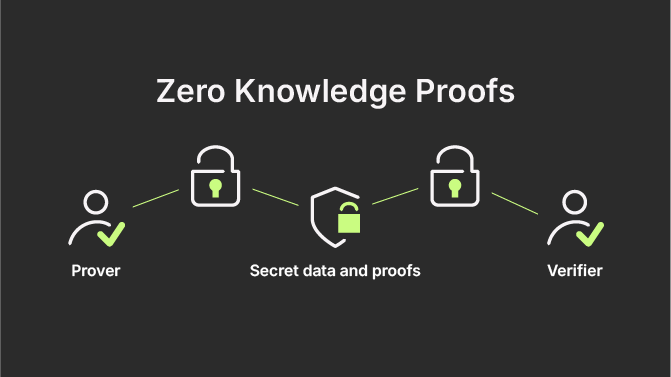
The following table summarizes the critical technical distinctions between these two proof systems, focusing on metrics that impact regulatory compliance and system architecture.
| Metric | ZK-SNARKs | ZK-STARKs |
|---|---|---|
| Proof Size | Small (~200 KB) | Large (1-10 MB) |
| Verification Speed | Fast | Slower |
| Trusted Setup | Required | Not Required |
| Quantum Resistance | No | Yes |
| Underlying Math | Elliptic Curves | Hash Functions |
For applications where bandwidth and verification latency are critical, such as high-frequency blockchain rollups, ZK-SNARKs remain the pragmatic choice despite the trusted setup requirement. Conversely, for environments prioritizing long-term security against quantum computing threats or requiring absolute transparency without trusted ceremonies, ZK-STARKs offer a robust, albeit heavier, alternative. As cryptographic engineering advances, the gap in proof size for STARKs is narrowing, potentially shifting this balance in the near future.
ZK-rollups and on-chain privacy
Zero-knowledge rollups (ZK-rollups) bundle hundreds of off-chain transactions into a single cryptographic proof that is verified on the main chain. This architecture allows the network to process transactions at scale without storing every individual data point on the blockchain. By keeping transaction details off-chain and only posting the proof and minimal state roots, ZK-rollups significantly reduce gas costs while maintaining the security guarantees of the underlying layer.
The privacy benefits of this model are distinct from public chains. Because the detailed transaction data remains off-chain, user activity is not visible to the public ledger. This creates a natural separation between execution and settlement. As noted by ZKProof, this approach is essential for mainstream adoption, allowing users to transact with confidentiality while still benefiting from decentralized security.
| Feature | ZK-Rollup | Optimistic Rollup |
|---|---|---|
| Verification | Cryptographic proof (ZKP) | Fraud proof challenge period |
| Finality Speed | Fast (minutes) | Slow (7 days) |
| Data Privacy | High (data off-chain) | Low (data on-chain) |
| Security Model | Mathematical validity | Economic penalties |
This structure also simplifies regulatory compliance. Since the rollup operator manages the off-chain data, they can implement privacy-preserving compliance tools, such as zero-knowledge identity verification, without exposing sensitive user information on the public blockchain. This allows institutions to meet anti-money laundering (AML) requirements while preserving user privacy. The Ethereum.org documentation highlights that this balance between validity and privacy is critical for enterprise-grade applications.
Meeting AML and KYC requirements with ZKPs
Institutional adoption of blockchain infrastructure is currently constrained by the privacy-compliance trilemma. Regulators demand full transparency for Anti-Money Laundering (AML) and Know Your Customer (KYC) protocols, while users and enterprises require data confidentiality. Zero-knowledge proofs resolve this conflict by allowing an institution to cryptographically prove that a transaction or user meets specific regulatory criteria without revealing the underlying identity or transaction details.
This capability shifts the compliance model from data collection to data verification. Instead of storing sensitive personal information in centralized databases—a primary target for cyberattacks—institutions can verify attributes such as "not on a sanctions list" or "age over 18" via a zero-knowledge proof. This approach aligns with the principles advocated by the ZKProof community, which emphasizes that privacy and regulatory adherence are not mutually exclusive but can be technologically integrated.
The following comparison illustrates how traditional compliance methods differ from ZK-based verification in terms of data exposure and regulatory utility.
By decoupling verification from disclosure, ZKPs enable institutions to maintain robust AML/KYC frameworks without compromising user privacy. This technical shift reduces liability associated with data breaches and aligns financial infrastructure with evolving global privacy laws.
Choosing the right ZK protocol for your use case
Selecting between SNARKs (Succinct Non-interactive Arguments of Knowledge) and STARKs (Scalable Transparent Arguments of Knowledge) requires balancing three competing constraints: proof generation cost, verification latency, and long-term security assumptions. There is no single optimal protocol; the choice depends on whether your application prioritizes immediate transaction throughput or cryptographic resilience against quantum computing advances.
SNARKs remain the industry standard for high-throughput applications like ZK-Rollups due to their small proof size and fast verification. However, they rely on trusted setup ceremonies and elliptic curve cryptography, which may be vulnerable to future quantum attacks. STARKs offer quantum resistance and transparency but currently suffer from larger proof sizes and higher computational overhead during generation.
The following comparison outlines the technical tradeoffs to guide your decision:
| Attribute | SNARKs | STARKs |
|---|---|---|
| Proof Size | Small (KB range) | Large (MB range) |
| Verification Speed | Fast | Slower |
| Quantum Resistance | No | Yes |
| Trusted Setup | Required | Not Required |
| Primary Use Case | ZK-Rollups, Identity | High-security audits |
For compliance-heavy environments where auditability is paramount, STARKs provide transparency by eliminating trusted setups. Conversely, for consumer-facing applications requiring minimal gas fees and rapid finality, SNARKs offer the necessary efficiency. Evaluate your specific latency and security requirements against these technical realities before committing to a protocol stack.
Frequently asked questions about ZK compliance
Regulators are shifting from skepticism to structured integration of zero-knowledge proofs. The following questions address the practical intersection of cryptographic privacy and legal compliance in 2026.
No comments yet. Be the first to share your thoughts!