
The shift from passwords to proofs
Traditional password-based authentication is failing in decentralized environments. Users routinely reuse credentials across platforms, creating a single point of failure that exposes entire digital identities. When centralized databases are breached, the resulting data leaks compromise millions of accounts, a risk that intensifies in Web3 where assets are directly tied to personal identity.
Zero-knowledge proofs (ZKPs) are emerging as the 2026 standard for identity verification by fundamentally changing how trust is established. Instead of sharing sensitive personal data, users generate cryptographic proofs that verify specific attributes without revealing the underlying information. This approach eliminates the need to store passwords or private keys in vulnerable centralized systems.
The core advantage of ZKPs is proving validity without revealing the statement itself, shifting the paradigm from data sharing to proof-based verification (Ethereum.org).
This transition addresses critical security and privacy gaps. By decoupling identity from data exposure, ZKPs allow users to prove eligibility for services—such as age verification or creditworthiness—without exposing their full identity. This reduces the attack surface for hackers and aligns with growing regulatory demands for data minimization.
The adoption of ZKPs is not merely a technical upgrade but a structural necessity for Web3 maturity. As regulatory frameworks tighten and user expectations for privacy rise, proof-based identity offers a scalable solution that balances security with user autonomy. This shift positions ZKPs as the foundational layer for next-generation digital identity systems.
ZK-SNARKs vs. STARKs in production
The choice between ZK-SNARKs and STARKs is no longer theoretical; it is a production constraint. For Web3 identity, the decision hinges on three practical metrics: proof size, verification speed, and trust setup requirements. While both systems achieve zero-knowledge privacy, their architectural differences dictate where they fit in the current 2026 landscape.
ZK-SNARKs (Succinct Non-Interactive Arguments of Knowledge) remain the incumbent standard for mobile and constrained environments. Their primary advantage is small proof size—typically under 200 bytes—which allows for cheap on-chain verification. However, this efficiency comes with a trade-off: a trusted setup ceremony is required during key generation. If the randomness used in this setup is compromised, the entire system’s security collapses. This trust assumption is a significant hurdle for identity protocols requiring long-term, decentralized assurance.
STARKs (Scalable Transparent Arguments of Knowledge) eliminate the trusted setup, relying instead on collision-resistant hash functions. This transparency makes them inherently more secure against setup failures. In addition, STARKs scale better with circuit complexity, meaning verification time does not grow linearly with the number of identity attributes. The cost is larger proof sizes—often several kilobytes—which increases gas costs for on-chain verification. As of 2026, this is less of a barrier due to L2 rollup efficiencies, but it remains a critical consideration for direct L1 deployment.
The following table compares these systems across key production parameters relevant to identity verification.
| Metric | ZK-SNARKs | STARKs |
|---|---|---|
| Proof Size | Small (~200-300 bytes) | Large (1-10 KB) |
| Verification Speed | Fast (constant time) | Fast (logarithmic time) |
| Trust Setup | Required (trusted ceremony) | None (transparent) |
| Quantum Resistance | No (based on elliptic curves) | Yes (based on hashes) |
| Best Use Case | Mobile wallets, L1 identity | High-volume L2 identity |
For identity applications, ZK-SNARKs are currently preferred for user-facing mobile wallets where bandwidth and storage are limited. The small proof size ensures fast sync times for light clients. In contrast, STARKs are gaining traction for high-throughput identity registries on Layer 2 networks, where their transparency and quantum resistance offer long-term security without the overhead of managing trusted setup ceremonies. The trend in 2026 is a hybrid approach: using SNARKs for user-side proof generation and STARKs for backend verification aggregation.
Real-world identity verification use cases
Zero-knowledge proofs have moved from theoretical cryptography to practical infrastructure, particularly in identity verification. As the European Union’s eIDAS regulation takes effect in 2026, the industry is shifting toward privacy-preserving age assurance. Instead of sharing full government IDs or birth dates, users can now generate proofs that confirm they meet specific legal thresholds, such as being over 18, without exposing the underlying data.
Google’s recent release of open-source ZKP libraries for age assurance highlights this shift. By providing standardized tools for developers, the company is lowering the barrier to entry for compliant, privacy-first authentication. This approach aligns with broader trends in Web3 identity, where verification of credentials or transaction validity occurs without revealing the sensitive information itself.
The visual architecture of these systems relies on complex cryptographic commitments. As illustrated in recent security research, the promise of ZKPs for blockchain privacy lies in their ability to decouple verification from revelation.
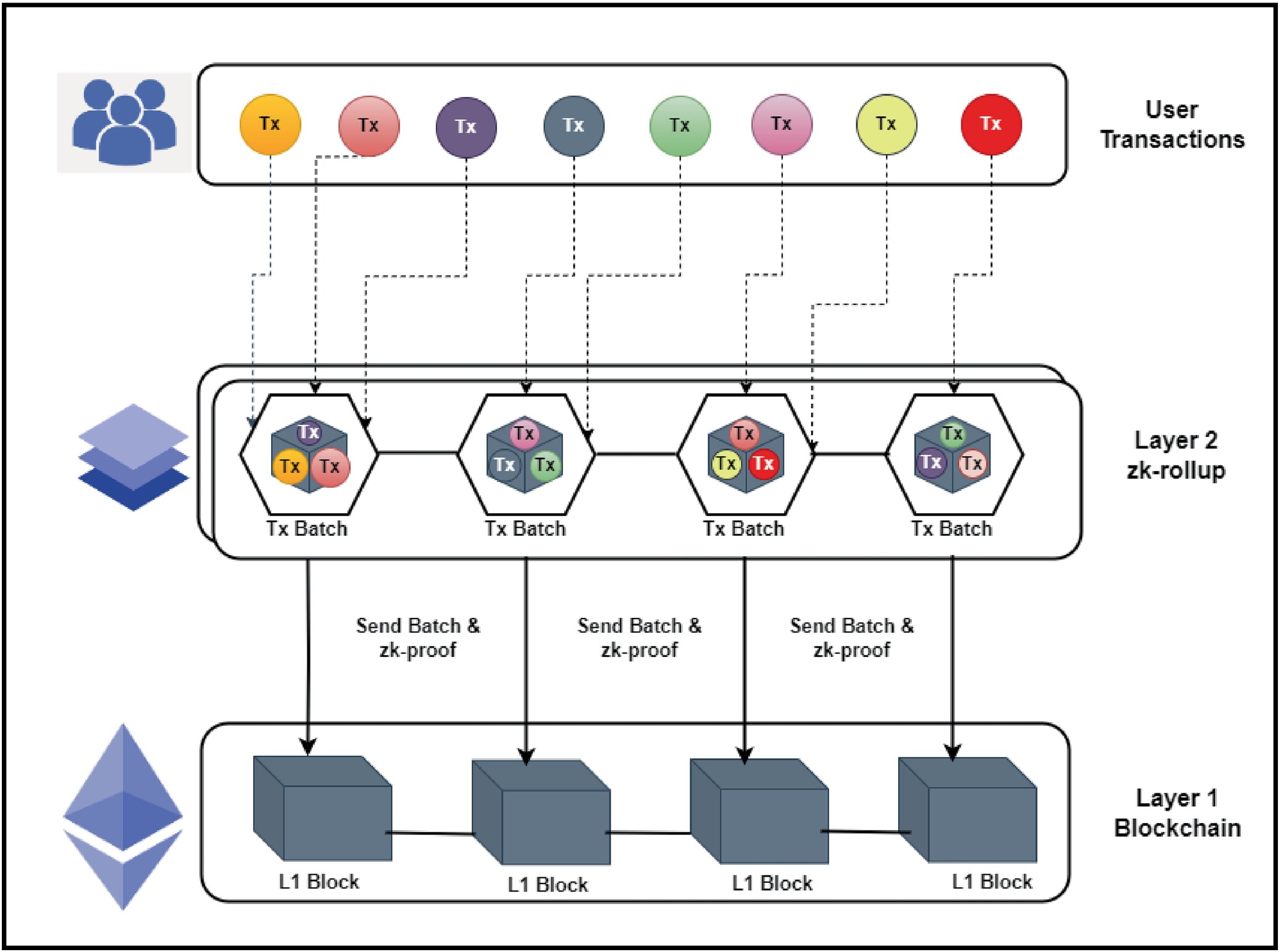
Beyond age verification, ZKPs are enabling anonymous transactions and credential checks in decentralized finance. Users can prove solvency or compliance with regulatory standards without disclosing their entire transaction history or balance. This capability is becoming a standard requirement for institutions seeking to operate in Web3 while maintaining strict data minimization principles.
Performance tradeoffs and costs
Deploying zero-knowledge proofs (ZKPs) introduces a distinct computational burden that shifts where processing happens. The prover must perform complex mathematical operations to generate the proof, which consumes significant CPU and memory resources. This overhead is the price paid for privacy and scalability; unlike a standard transaction that merely records data, a ZK transaction requires generating a cryptographic guarantee of correctness.
To manage this load, most ZK applications rely on off-chain proving. The heavy lifting occurs in a trusted execution environment or a dedicated proving service, after which only the compact proof and verification key are submitted to the blockchain. This architecture prevents the network from being bogged down by intensive calculations, but it introduces latency between the action and final settlement. Users must account for the time required to generate the proof, which can range from seconds to minutes depending on the circuit complexity.
On-chain verification remains relatively cheap, but it is not free. The cost of verifying a ZK proof is determined by the gas required for the verifier contract logic. As shown in the chart below, Ethereum gas prices fluctuate, directly impacting the economic viability of high-frequency ZK applications. When gas spikes, the cost of submitting proofs can become prohibitive for small-scale transactions.
The economic model also depends on the type of proof system used. Systems like SNARKs offer small proof sizes and fast verification, making them ideal for state channels and rollups where on-chain space is at a premium. STARKs provide quantum resistance and transparent setup but typically result in larger proofs and higher verification costs. Choosing between them requires balancing the need for immediate finality against long-term security assumptions and gas efficiency.
Choosing a ZK standard for your project
Selecting a zero-knowledge protocol is a foundational infrastructure decision. In 2026, the landscape is defined by three primary standards: ZK-SNARKs, ZK-STARKs, and the emerging Plonky2 family. Your choice depends on your specific constraints regarding trust assumptions, proof generation speed, and verification cost.
ZK-SNARKs: The Mature Standard
ZK-SNARKs (Succinct Non-Interactive Arguments of Knowledge) remain the most widely deployed standard for identity solutions. They offer the smallest proof sizes, which minimizes on-chain verification costs. However, they require a trusted setup ceremony. This initial phase introduces a small, one-time risk if the entropy source is compromised, though many projects now use multi-party computation to mitigate this.
Use ZK-SNARKs if you prioritize low verification gas fees and have a mature user base. They are the default choice for most existing identity protocols, including those building on Ethereum.
ZK-STARKs: Quantum Resistance and Transparency
ZK-STARKs (Scalable Transparent Arguments of Knowledge) eliminate the need for a trusted setup, relying instead on public randomness. This makes them more transparent and theoretically quantum-resistant. The trade-off is larger proof sizes, which increases the computational load for verifiers.
Choose ZK-STARKs if your project requires maximum transparency or anticipates a post-quantum threat model. They are ideal for high-security financial applications where the cost of verification is secondary to the guarantee of no trusted setup.
Plonky2: Speed for Off-Chain Identity
Plonky2 focuses on extremely fast prover times, making it suitable for applications where generating proofs is frequent, such as real-time identity verification. It is often used in conjunction with other schemes to handle the heavy lifting of proof generation off-chain.
Consider Plonky2 if your identity flow requires high throughput and low latency for the user. It is less about the final on-chain proof size and more about the developer experience and prover efficiency during the credential issuance phase.
No comments yet. Be the first to share your thoughts!