
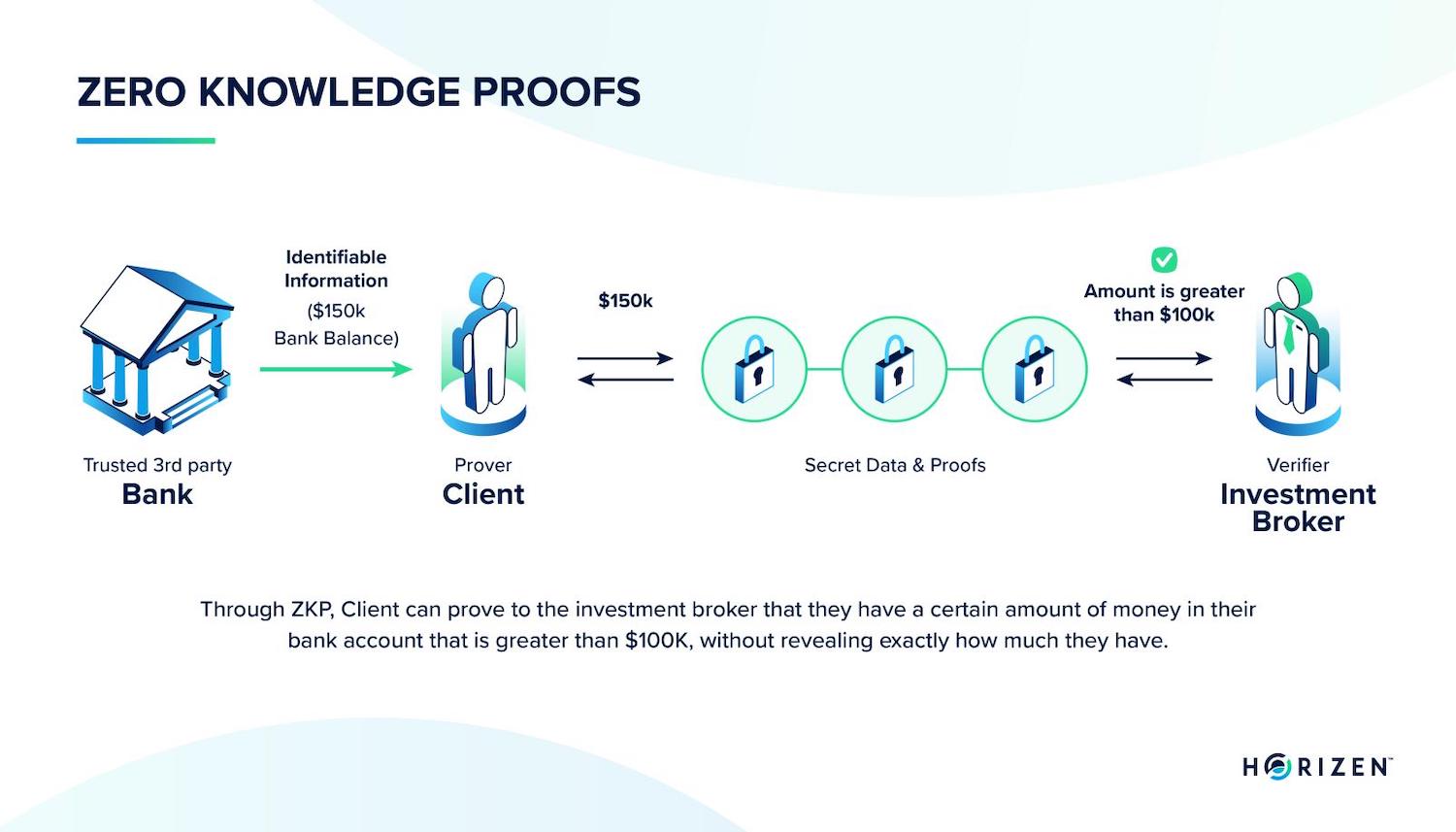
What zero-knowledge proofs verify
Zero-knowledge proofs (ZKPs) are a cryptographic method that allows one party to prove the truth of a statement without revealing the underlying data itself. In the context of identity verification, this means a user can demonstrate they meet specific criteria—such as being over 18 or holding a valid government ID—without exposing their actual birthdate, full name, or document images to the verifier.
Traditional identity verification operates on a model of data minimization failure: the verifier collects excessive personal information to confirm a single attribute. ZKPs invert this dynamic. The prover generates a cryptographic proof that validates a claim against a set of rules. The verifier receives only the boolean result—true or false—along with a mathematical guarantee that the proof was generated correctly. No personal identifiers, transaction histories, or biometric data are transferred or stored during this exchange.
This mechanism aligns with the principles of data minimization required by GDPR. By shifting from data collection to data verification, organizations can comply with privacy regulations while maintaining robust security standards. The verifier learns nothing beyond the validity of the claim, effectively eliminating the risk of data breaches exposing sensitive personal information.
| Feature | Traditional KYC | Zero-Knowledge Proof |
|---|---|---|
| Data Shared | Full name, ID image, DOB | Cryptographic proof of attribute |
| Storage Risk | High (centralized databases) | None (ephemeral verification) |
| Verification | Manual or basic OCR check | Mathematical consensus |
| Privacy | Low (data exposed to verifier) | High (data remains private) |
The technical implementation relies on complex algebraic structures, but the user experience remains simple. A user initiates a proof request, the system generates the ZKP locally, and the verifier instantly confirms its validity. This process ensures that identity verification is both secure and privacy-preserving, establishing a new standard for digital trust.
Traditional KYC vs. zero-knowledge proofs for identity
Legacy Know Your Customer (KYC) workflows operate on a model of data hoarding. To verify identity, institutions require users to upload passports, selfies, and utility bills. This centralizes sensitive personal information, creating high-value targets for breaches and increasing liability under GDPR. The traditional process treats identity verification as a data transfer, not a data minimization exercise.
Zero-knowledge proofs (ZKPs) flip this paradigm. As defined by ethereum.org, a ZKP allows a prover to demonstrate the truth of a statement without revealing the underlying data. In an identity context, this means verifying a user is over 18 or a citizen of a specific jurisdiction without exposing their name, date of birth, or address. The verifier learns only that the condition is met, not what the data is.
The shift from data hoarding to data minimization is not just technical; it is a regulatory imperative. By keeping personal data on the user’s device and only transmitting cryptographic proofs, organizations significantly reduce their attack surface. This approach aligns directly with GDPR’s data protection by design principles, limiting exposure while maintaining compliance.
| Feature | Traditional KYC | Zero-Knowledge Identity |
|---|---|---|
| Data Storage | Centralized server databases | User-held, decentralized |
| Privacy Risk | High (single point of failure) | Low (data never leaves user) |
| Compliance | Requires strict data handling protocols | Built-in data minimization |
| Verification | Full PII disclosure | Proof of attribute only |
The adoption of ZKPs represents a fundamental change in how identity is managed in the digital age. It moves the industry away from trusting third-party validators with raw data toward trusting mathematical proofs of validity.
GDPR alignment and data minimization
Zero-knowledge proofs (ZKPs) shift the burden of proof from data storage to cryptographic verification. For organizations subject to the General Data Protection Regulation (GDPR), this architectural change directly addresses two of the most stringent compliance requirements: data minimization and purpose limitation. By proving a statement is true without revealing the underlying data, companies can significantly reduce their legal exposure.
Satisfying data minimization
Article 5(1)(c) of the GDPR mandates that personal data be "adequate, relevant and limited to what is necessary." Traditional identity verification requires collecting and storing sensitive attributes—such as full names, birth dates, or government ID numbers—creating a high-value target for attackers and a compliance liability.
ZKPs allow a verifier to confirm a specific claim without accessing the raw data. For example, a user can prove they are over 18 without revealing their exact birth date or full name. This approach ensures that only the minimum necessary information is processed, aligning perfectly with the principle of data minimization. As NIST notes, ZKPs are a primary tool of Privacy-Enhancing Cryptography (PEC) for enabling truthfulness without disclosure.
Enforcing purpose limitation
Purpose limitation restricts data processing to the specific, explicit purposes for which it was collected. When companies hoard data "just in case" it is needed for future marketing or secondary analysis, they violate this principle. ZKPs enforce a strict boundary: the verifier learns only that the condition was met. They gain no insight into other attributes, making it technically impossible to repurpose the data for unintended uses.
Compliance comparison
The table below contrasts traditional verification with ZKP-based verification under GDPR principles.
| GDPR Principle | Traditional Verification | ZKP Verification |
|---|---|---|
| Data Minimization | Collects full identity profile, including unnecessary details | Reveals only the specific attribute needed for the check |
| Purpose Limitation | Stored data is available for secondary, unapproved uses | Verifier learns nothing beyond the truth of the statement |
| Storage Limitation | Permanent records of sensitive PII require strict retention policies | No PII is stored by the verifier, eliminating retention risks |
| Security by Design | Centralized databases are high-value targets for breaches | Sensitive data remains on the user’s device, not in transit |
Reducing legal liability
By eliminating the storage of raw personally identifiable information (PII), organizations drastically reduce their attack surface. In the event of a breach, a ZKP-based system holds no sensitive user data to steal. This not only mitigates the financial impact of potential fines but also simplifies the process of demonstrating compliance during regulatory audits. The cryptographic proof serves as an immutable record that the verification occurred within the bounds of privacy-by-design principles.
Implementing ZK Identity in 2026
Deploying zero-knowledge identity systems requires moving beyond theoretical cryptography into structured protocol selection. In 2026, the standard for GDPR-compliant identity relies on integrating ZKPs with decentralized identity frameworks like W3C Verifiable Credentials. This approach ensures that personal data remains encrypted while still satisfying regulatory verification requirements.
The primary challenge lies in selecting the right proof system. SNARKs offer compact verification but require a trusted setup, which may conflict with strict compliance mandates. STARKs provide post-quantum security and transparency but demand significantly more computational resources. The choice depends on whether your infrastructure prioritizes low-latency mobile verification or high-volume batch processing.
| Feature | SNARKs | STARKs |
|---|---|---|
| Verification Speed | Fast | Slower |
| Proof Size | Small | Large |
| Trusted Setup | Required | Not Required |
| Quantum Resistance | No | Yes |
Integration with existing identity providers is the next critical step. Systems must interface with decentralized identifiers (DIDs) to issue credentials that can be selectively disclosed. This architecture allows users to prove attributes—such as age or residency—without exposing the underlying data. Ethereum.org explains how these proofs validate statements without revealing their contents, a principle essential for privacy-preserving identity.
Adoption trends in ZK infrastructure are accelerating, as reflected in the broader market interest in privacy-preserving technologies. The chart above illustrates the correlation between ZK protocol development and Ethereum ecosystem growth, signaling strong institutional confidence in this standard.
Common questions about ZK identity
Zero-knowledge proofs (ZKP) are cryptographic protocols that allow a prover to convince a verifier that a statement is true without revealing any underlying data. This technology enables identity verification without exposing personally identifiable information (PII), aligning directly with GDPR’s data minimization principles.
For example, you can prove you are over 18 to a website without revealing your exact birthdate or name. By verifying a digital signature from a government-issued passport, the system confirms the age threshold is met while keeping your identity private. This is akin to a tamper-proof stamp on an opaque envelope: the recipient knows the contents are valid but cannot see what is inside.
No comments yet. Be the first to share your thoughts!