
ZK proof standards for 2026
ZKProof remains the primary governing authority for zero-knowledge cryptography, driving the standardization efforts that allow ZK-SNARKs and ZK-STARKs to function reliably across different blockchain ecosystems. As an open-industry academic initiative, the organization ensures that the complex mathematics behind privacy proofs are rigorously tested and documented for institutional adoption.
By 2026, the maturity of these standards has shifted the industry from experimental protocols to production-grade infrastructure. The distinction between SNARKs and STARKs is no longer just theoretical; it is defined by clear standards for verification speed, proof size, and post-quantum security. This standardization allows developers to choose the right cryptographic tool for their specific privacy requirements without reinventing the underlying security models.
ZKProof is an open-industry academic initiative that seeks to mainstream zero-knowledge proof (ZKP) cryptography. Refer to zkproof.org for official standards.
The Ethereum ecosystem serves as the primary reference point for these advancements. According to ethereum.org, zero-knowledge proofs provide a way of proving the validity of a statement without revealing the statement itself. This fundamental property, now codified under robust standards, enables institutions to verify transactions without exposing sensitive data, marking a significant milestone for financial privacy.
Zk-snarks versus zk-starks choices that change the plan
The choice between ZK-SNARKs and ZK-STARKs is not merely technical; it is a strategic decision affecting latency, security assumptions, and long-term viability. SNARKs (Succinct Non-Interactive Arguments of Knowledge) and STARKs (Scalable Transparent Arguments of Knowledge) offer distinct paths to zero-knowledge verification. Understanding their tradeoffs is essential for selecting the right cryptographic tool for a given use case.
Proof Size and Verification Speed
SNARKs are defined by their succinctness. A typical SNARK proof is very small (often under 200 bytes) and verifies extremely quickly, even on constrained devices like mobile phones. This efficiency makes SNARKs the default choice for Layer 2 rollups where block space is scarce and transaction throughput is paramount. However, this efficiency comes with a trusted setup requirement for many SNARK schemes, which introduces a potential point of failure if the initial parameters are compromised.
STARKs, by contrast, produce larger proofs—often several kilobytes. While verification is still fast, the larger proof size consumes more bandwidth and storage. STARKs do not require a trusted setup, relying instead on publicly verifiable randomness. This transparency eliminates the risk of a "toxic waste" scenario where secret parameters could allow an attacker to forge proofs. For applications prioritizing long-term security and decentralization over minimal proof size, STARKs are increasingly favored.
Quantum Resistance and Security Assumptions
As quantum computing advances, the cryptographic assumptions underpinning SNARKs become a concern. Many SNARKs rely on elliptic curve cryptography, which is vulnerable to Shor’s algorithm. STARKs, however, are built on hash-based cryptography, making them inherently quantum-resistant. This future-proofing is a significant advantage for financial institutions and infrastructure providers looking to secure data for decades.
The table below summarizes the core technical differences between these two proof systems.
| Feature | ZK-SNARKs | ZK-STARKs | Best For |
|---|---|---|---|
| Proof Size | Very small (~200 bytes) | Larger (KB range) | SNARKs |
| Verification Speed | Extremely fast | Fast | SNARKs |
| Trusted Setup | Often required | Not required | STARKs |
| Quantum Resistance | No (relies on ECC) | Yes (hash-based) | STARKs |
| Transparency | No (often requires CRS) | Yes (public randomness) | STARKs |
Market Context and Adoption
The preference for one system over the other often reflects broader market trends. SNARKs currently dominate the Layer 2 landscape due to their efficiency, with protocols like zkSync and StarkEx (now Starknet) leveraging different aspects of these technologies. However, as security concerns grow and quantum threats loom, STARKs are gaining traction in high-stakes environments where transparency and quantum resilience are non-negotiable.
The adoption of ZK technology is also expanding beyond Ethereum. For instance, the XRP Ledger has recently integrated with Boundless to support native ZK verification, allowing institutions to verify transactions without revealing sensitive data. This cross-chain development highlights the growing importance of choosing a ZK system that balances immediate performance with long-term security guarantees.
ZK identity verification use cases
Zero-knowledge proofs are moving from theoretical cryptography to practical identity infrastructure, offering a way to verify credentials without exposing the underlying data. This capability is critical for privacy-preserving age assurance and digital credentialing, where regulatory compliance often conflicts with user data protection. By proving a statement is true without revealing the information itself, ZKPs allow users to demonstrate eligibility—such as being over 18 or holding a specific degree—while keeping their personal details private.
Google has taken significant steps in this direction by open-sourcing its ZKP libraries specifically for age assurance. This initiative aims to support EU regulatory frameworks by enabling websites to verify age without storing or processing sensitive birth date information. The move signals a shift toward standardized, transparent protocols that balance legal requirements with user privacy, reducing the reliance on centralized databases of personal data.
In the Web3 space, identity verification is being integrated directly into blockchain protocols. The XRP Ledger, for instance, has partnered with Boundless to introduce native ZKP verification. This integration allows institutions to verify transaction details—such as compliance with anti-money laundering rules—without revealing the sender, receiver, or transaction amount. Such implementations demonstrate how ZKPs can serve as a privacy layer for financial identity, enabling transparency for regulators while maintaining confidentiality for users.
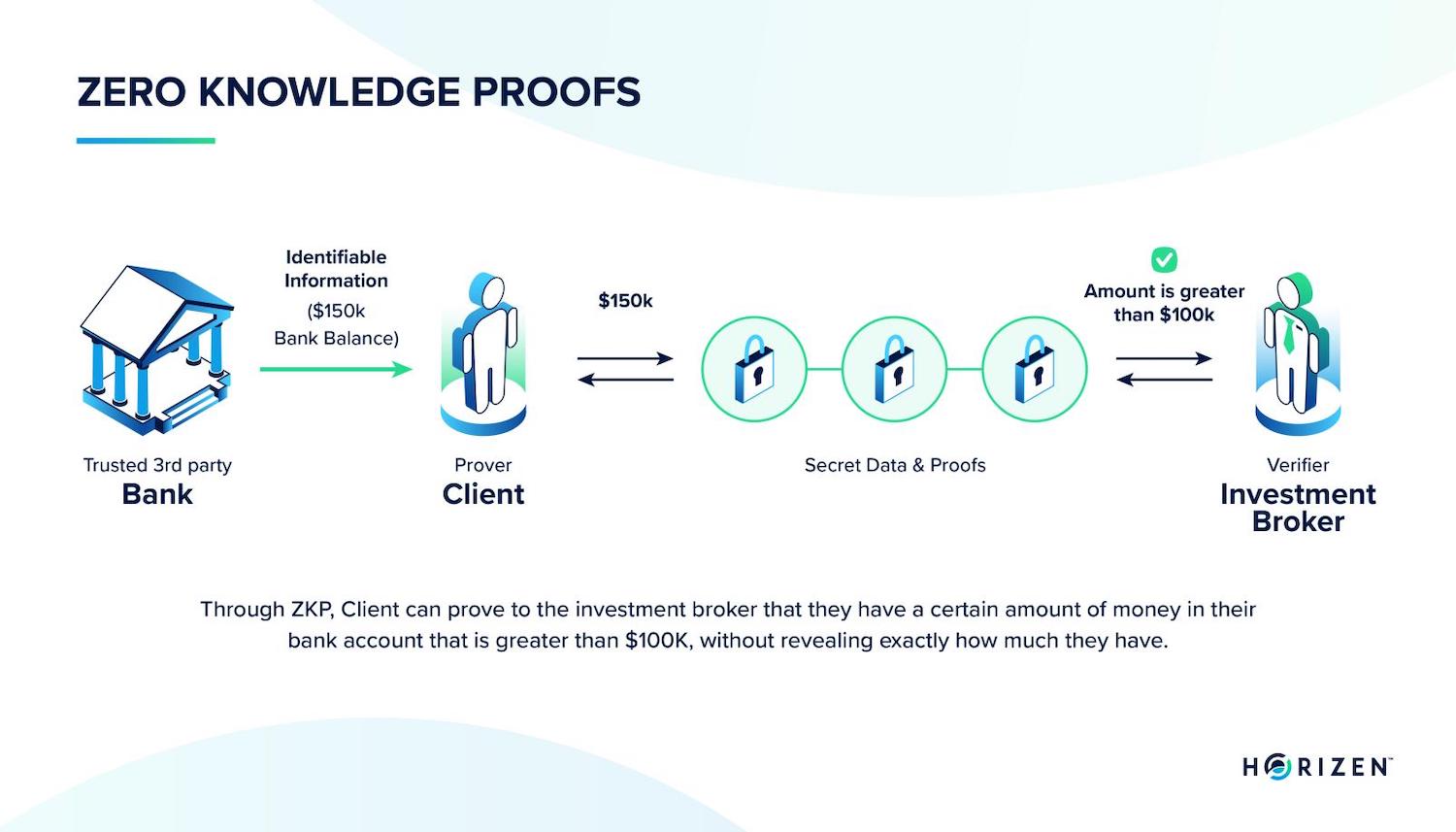
These developments highlight a broader trend: ZKPs are becoming essential for secure, privacy-first societies. As NTT DATA notes, the technology is evolving from a niche cryptographic tool to a foundational element of future digital infrastructure. The focus is no longer just on whether ZKPs work, but on how they can be seamlessly integrated into existing identity systems to protect user data at scale.
Privacy in DePIN and blockchain finance
Zero-knowledge proofs are shifting from theoretical cryptography to core infrastructure for decentralized physical networks (DePIN) and institutional finance. The technology allows nodes to verify data integrity without exposing sensitive operational details, solving the "privacy vs. transparency" dilemma that has long stalled enterprise adoption.
In DePIN, providers must prove they have fulfilled physical obligations—such as storing data or providing compute power—without revealing proprietary infrastructure layouts or customer usage patterns. ZKPs enable this verification cryptographically, ensuring that network consensus remains secure while keeping business-critical metrics confidential. This capability is essential for attracting traditional logistics and cloud providers who cannot risk exposing their operational data on public ledgers.
Blockchain finance faces similar pressures. Regulatory compliance requires transparency, but institutional traders and clients demand confidentiality regarding trade flows and counterparty identities. Nethermind notes that ZKPs allow institutions to keep trading flows private while still satisfying audit requirements. By proving compliance without exposing underlying data, financial entities can integrate Web3 infrastructure without violating client confidentiality agreements or exposing market-sensitive information.
The integration of these protocols is already visible. The XRP Ledger recently integrated with Boundless, bringing native zero-knowledge proof verification to the chain. This allows institutions to verify transactions without revealing amounts, senders, or receivers, marking a significant step toward mainstream financial privacy. As regulatory frameworks evolve, the ability to prove validity without revealing data will likely become the standard for institutional-grade blockchain applications.
Market performance and adoption
Zero-knowledge proof technology is transitioning from academic theory to institutional infrastructure. The ZKProof initiative continues to standardize cryptographic protocols, ensuring that privacy-preserving transactions meet rigorous security benchmarks before entering mainstream finance. This standardization is a prerequisite for the institutional adoption we are seeing in 2026.
The market response reflects this shift. Capital is flowing toward projects that successfully integrate ZK-SNARKs and ZK-STARKs into scalable, low-latency environments. The following chart illustrates the correlation between cryptographic advancements and asset performance, highlighting how technical maturity drives market confidence.
Adoption is no longer limited to niche privacy coins. Major networks are embedding ZK verification natively, as seen with the XRP Ledger’s integration with Boundless. This allows institutions to verify transaction validity without exposing sender, receiver, or amount data, bridging the gap between regulatory compliance and user privacy.
Frequently asked: what to check next
Is zero-knowledge proof the future?
Zero-knowledge proofs are transitioning from theoretical cryptography to essential infrastructure for secure digital societies. As privacy regulations tighten, ZK technology will likely become the standard for verifying identity and transactions without exposing sensitive data, ensuring that high-level privacy requirements can be met at scale.
Does XRP use zero-knowledge proof?
Yes. The XRP Ledger has integrated with Boundless to bring native zero-knowledge proof verification to the network. This upgrade allows institutions to verify transactions without revealing amounts, senders, or receivers, marking a significant step toward institutional-grade privacy on the ledger.
What is the difference between ZK-SNARKs and ZK-STARKs?
ZK-SNARKs are smaller and faster to verify but require a trusted setup, which introduces potential security risks if the initial parameters are compromised. ZK-STARKs are quantum-resistant and do not require a trusted setup, but their proofs are larger and more computationally intensive to generate. The choice depends on whether you prioritize verification speed or long-term security guarantees.
No comments yet. Be the first to share your thoughts!