
Why ZKPs matter for 2026 privacy
Use this section to make the Zero-Knowledge Proofs decision easier to compare in real life, not just on paper. Start with the reader's actual constraint, then separate must-have requirements from details that are merely nice to have. A practical choice should survive normal use, maintenance, timing, and budget. If a recommendation only works in an ideal situation, call that out plainly and give the reader a fallback path.
The simplest way to use this section is to write down the must-have criteria first, then compare each option against those criteria before weighing nice-to-have features.
Comparing ZK Protocols for Compliance
Selecting a zero-knowledge proof system for regulatory reporting requires balancing proof generation latency against verification efficiency. In a 2026 compliance context, the choice between Succinct Non-Interactive Arguments of Knowledge (SNARKs) and Scalable Transparent Arguments of Knowledge (STARKs) hinges on specific legal and technical constraints. SNARKs offer smaller proof sizes, which reduces data storage costs for auditors, while STARKs provide post-quantum security guarantees that may protect long-term archival records from future decryption threats.
The following table outlines the primary technical distinctions relevant to high-stakes regulatory environments. These metrics are derived from current industry standards and academic benchmarks provided by ZKProof and Ethereum.org.
| Feature | SNARKs | STARKs | Bulletproofs |
|---|---|---|---|
| Proof Size | Small (KB) | Medium (KB-MB) | Small (KB) |
| Verification Speed | Fast | Moderate | Slow |
| Post-Quantum Security | No | Yes | No |
| Trusted Setup | Often Required | No | No |
| Best Use Case | Mobile/On-chain | Archival/Large Data | Privacy Coins |
For compliance teams managing large-scale transaction data, the computational cost of proof generation often outweighs the benefit of minimal proof size. STARKs eliminate the need for a trusted setup, removing a significant legal liability associated with private key management during the ceremony phase. This transparency aligns with regulatory preferences for verifiable, trust-minimized infrastructure. However, the larger proof size of STARKs can increase bandwidth and storage expenses for nodes validating compliance reports.
Conversely, SNARKs remain the standard for real-time verification due to their compact size and rapid verification times. This efficiency is critical for applications requiring immediate audit trails, such as high-frequency trading compliance or instant identity verification. The primary drawback is the reliance on a trusted setup, which introduces a single point of failure if the initial parameters are compromised. Regulatory bodies may scrutinize any system dependent on trusted setups more heavily, requiring additional legal assurances regarding the security of the setup ceremony.
Bulletproofs offer a middle ground for specific use cases, particularly where privacy is paramount and proof size must remain small without a trusted setup. However, their slower verification speed makes them less suitable for high-throughput compliance reporting. For most enterprises, the decision rests on whether the priority is immediate verification efficiency (SNARKs) or long-term security and transparency (STARKs).
The economic implications of these technical choices are reflected in the broader cryptocurrency market. As regulatory clarity increases, the demand for compliant ZK infrastructure grows, influencing the valuation of projects that successfully integrate these protocols. Understanding the trade-offs between SNARKs and STARKs is essential for any organization looking to future-proof their compliance strategy.
GDPR alignment and data minimization
The General Data Protection Regulation (GDPR) mandates that personal data be adequate, relevant, and limited to what is necessary for the purposes for which they are processed. This principle, known as data minimization, creates a significant friction point for traditional identity verification systems, which typically require the transmission of full documents or raw biometric data to prove an attribute. Zero-knowledge proofs (ZKPs) resolve this conflict by allowing a prover to demonstrate the validity of a claim without revealing the underlying statement itself.
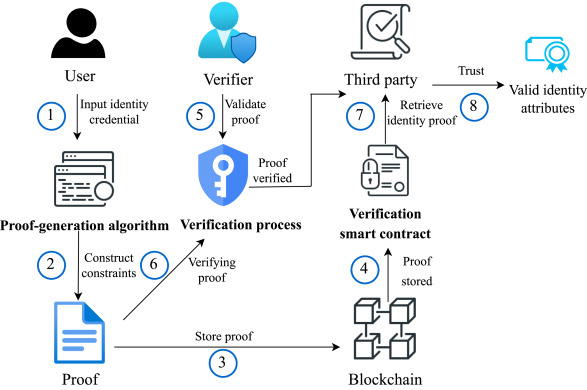
As defined by Ethereum.org, a zero-knowledge proof is a cryptographic method that enables one party to prove to another that a statement is true without conveying any information apart from the fact that the statement is indeed true. In a compliance context, this means an individual can prove they are over 18, or that they hold a valid passport, without exposing their birth date, passport number, or photograph. The verification cost remains low for the recipient, while the proof size remains compact enough for efficient blockchain or database storage.
This approach shifts the security model from protecting data in transit and at rest to protecting the privacy of the data itself. Nethermind notes that ZKPs allow institutions to keep trading flows and customer data private while still satisfying regulatory obligations. By verifying attributes rather than raw data, organizations reduce their liability surface area. If a breach occurs, there is no sensitive personal information to steal, only the public verification keys and the zero-knowledge proofs, which are useless without the original witness data.
Implementation tradeoffs in 2026
Use this section to make the Zero-Knowledge Proofs decision easier to compare in real life, not just on paper. Start with the reader's actual constraint, then separate must-have requirements from details that are merely nice to have. A practical choice should survive normal use, maintenance, timing, and budget. If a recommendation only works in an ideal situation, call that out plainly and give the reader a fallback path.
The simplest way to use this section is to write down the must-have criteria first, then compare each option against those criteria before weighing nice-to-have features.
No comments yet. Be the first to share your thoughts!