
Why ZK-Rollups 2026 Matter for Compliance
The narrative around zero-knowledge rollups has shifted from speculative scaling to regulated enterprise utility. In 2026, the primary value proposition is no longer just throughput; it is the ability to process high-volume transactions while maintaining strict adherence to data privacy laws like GDPR and CCPA.
Traditional blockchain transparency creates a compliance paradox: financial regulations require immutability, yet privacy laws demand the right to be forgotten. ZK-rollups resolve this conflict by batching thousands of transactions off-chain and submitting a single cryptographic validity proof to Ethereum. This proof verifies the entire batch without revealing the underlying data. As a result, enterprises can audit the integrity of their ledger while keeping sensitive customer information off the public chain entirely.
This architecture offers faster finality than optimistic rollups, which rely on challenge periods. For regulated industries, this speed and privacy are not optional features but foundational requirements for institutional adoption. The technology transforms blockchain from a public record into a compliant, private ledger.
How ZK-Proofs Enable Data Privacy
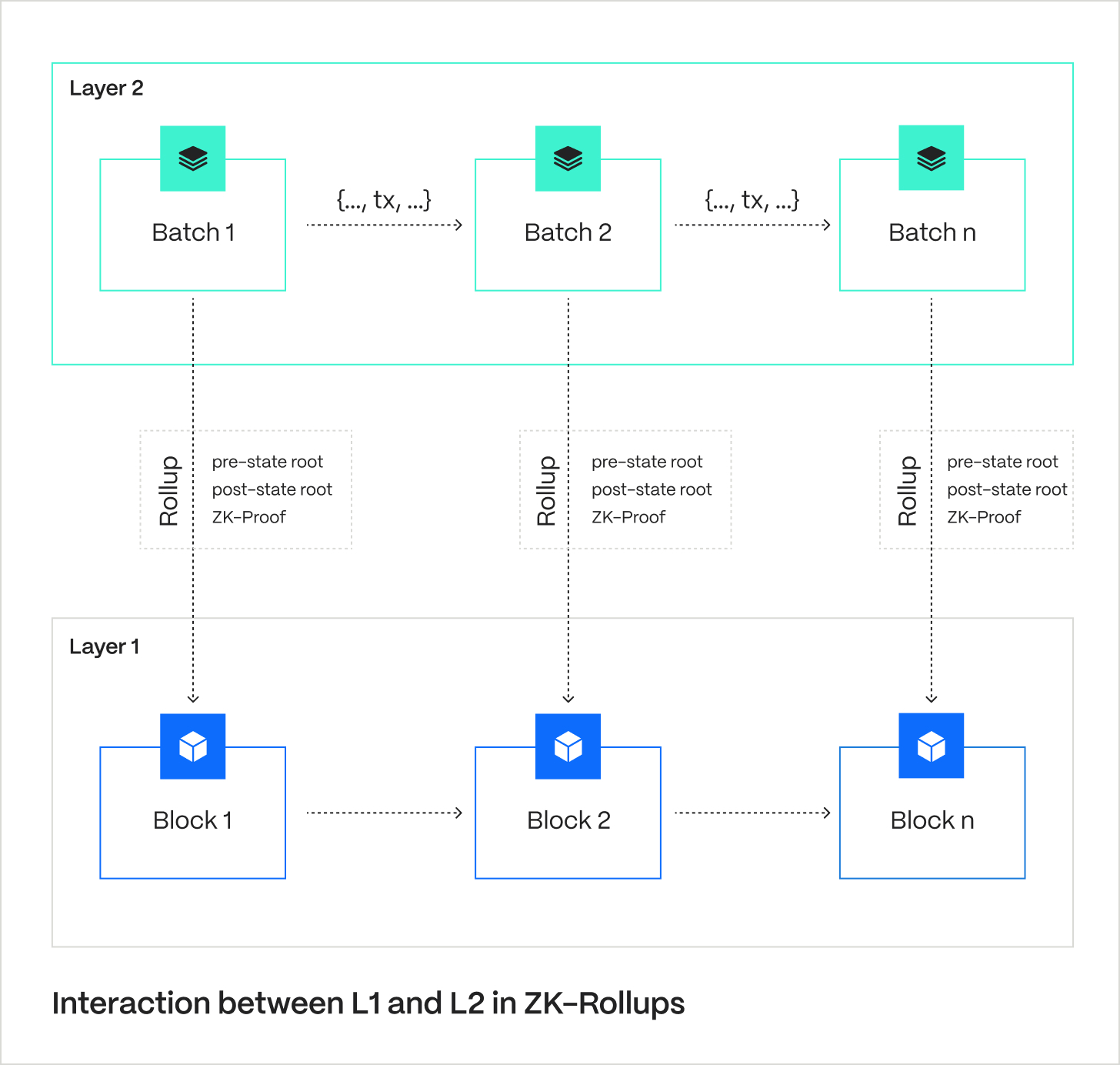
ZK-rollups function as a privacy-preserving ledger by separating execution from verification. Instead of broadcasting every transaction detail to the main chain, these systems batch thousands of operations off-chain. The network then generates a single cryptographic validity proof that confirms the entire batch is mathematically correct without revealing the underlying data.
This mechanism allows enterprises to keep sensitive information private while still benefiting from the security of the base layer. The proof acts as a seal of integrity. If the proof validates, the base chain accepts the state update as true. If the data were tampered with, the proof would fail to generate, and the transaction would be rejected. This ensures that compliance requirements are met without exposing raw customer or financial data to the public blockchain.
The distinction between ZK-rollups and other scaling solutions is clear. Optimistic rollups assume transactions are valid and rely on a challenge period to catch errors. ZK-rollups, by contrast, provide immediate finality through cryptographic proof. This makes them ideal for high-stakes environments where speed and data confidentiality are equally critical.
Leading zkEVM Projects for Enterprise
Enterprise teams selecting a zkEVM rollup must weigh EVM equivalence against security models and finality speeds. The four dominant general-purpose zkEVMs—zkSync, Polygon, Linea, and Starknet—offer distinct trade-offs for compliance and privacy needs.
Polygon zkEVM targets full bytecode-level EVM equivalence, allowing Solidity and Vyper contracts to deploy without modification. It uses SNARKs for validity proofs, offering faster withdrawal finality compared to optimistic rollups because users do not wait for a challenge period. This compatibility makes it a practical choice for migrating existing enterprise dApps with minimal refactoring.
zkSync Era prioritizes high throughput and cost efficiency, reducing Ethereum gas fees by up to 99% through transaction bundling. It uses SNARKs and maintains a high degree of EVM compatibility, though some specific opcodes may require adjustments. Its architecture is optimized for financial applications where transaction volume and low latency are critical.
Linea, developed by ConsenSys, emphasizes EVM equivalence and security through SNARK proofs. It leverages the broader Ethereum ecosystem and MetaMask infrastructure, making it easier for Web3-native enterprises to integrate. Its focus on developer experience and seamless Ethereum integration supports rapid deployment of privacy-preserving applications.
Starknet stands out by using STARKs instead of SNARKs, eliminating the need for a trusted setup and offering quantum resistance. While it uses a custom Cairo language rather than pure Solidity, its high throughput and scalability make it suitable for complex, high-volume enterprise workloads. The trade-off is a steeper learning curve for developers accustomed to the EVM.
The following table compares these platforms across key technical dimensions relevant to enterprise decision-making.
| Project | Proof Type | EVM Compatibility | Finality Speed | Best For |
|---|---|---|---|---|
| Polygon zkEVM | SNARK | Bytecode-level | Fast | Migration & Compatibility |
| zkSync Era | SNARK | High (Opcode adjustments) | Fast | High-Volume Finance |
| Linea | SNARK | High | Fast | Ecosystem Integration |
| Starknet | STARK | Low (Cairo) | Medium | Complex Scaling & Quantum Safety |
Proving Compliance Without Leaking Data
Regulators demand transparency, but ZK-Rollups hide transaction details to protect privacy. This creates a paradox: how do you prove compliance when the data is encrypted? The solution lies in zero-knowledge proofs that allow selective disclosure. Instead of revealing raw user data, enterprises can generate cryptographic proofs that verify specific conditions—such as age, residency, or transaction limits—without exposing the underlying information.
This approach transforms compliance from a data dump into a precise verification process. Auditors can confirm that a batch of transactions adheres to regulatory frameworks without seeing who was involved or how much was moved. This balance is critical for institutional adoption, as it satisfies legal requirements while maintaining the core privacy benefits of ZK-Rollups.
Audit Trails and Key Management
Beyond selective disclosure, the integrity of the audit trail is paramount. Every ZK-Rollup batch must be backed by a valid cryptographic proof posted to the Ethereum mainnet. This creates an immutable record that regulators can independently verify. However, the security of this system depends entirely on key management. If the private keys used to generate proofs are compromised, the entire audit trail becomes suspect.
Enterprises must implement rigorous key management protocols, including hardware security modules (HSMs) and multi-signature schemes. This ensures that only authorized personnel can initiate transactions or generate proofs. Without this layer of security, the cryptographic guarantees of ZK-Rollups are meaningless, exposing the enterprise to significant legal and financial risk.
Choosing a ZK-Rollup for Your Stack
Enterprise teams selecting a ZK-Rollup must balance three competing forces: cryptographic overhead, settlement speed, and regulatory visibility. Unlike Optimistic Rollups, which rely on a seven-day challenge window for fraud proofs, ZK-Rollups generate a validity proof for every batch before finalization [[src-serp-5]]. This architectural difference dictates how you structure your compliance and data privacy workflows.
Common Questions on ZK-Rollups
What does zk rollup mean?
A ZK rollup is a Layer 2 scaling solution that processes transactions off-chain and posts a zero-knowledge validity proof to the main chain. This allows the base layer to verify the batch without re-executing every transaction, ensuring both high throughput and cryptographic security.
What is the difference between an optimistic rollup and a ZK rollup?
Optimistic rollups assume transactions are valid by default and use a fraud-proof challenge window to catch errors. ZK rollups generate a cryptographic validity proof for every batch before finalization. This means ZK rollups offer faster finality and don't require users to wait for a challenge period when withdrawing funds.
Is Polygon a ZK rollup?
Yes. Polygon zkEVM is a ZK rollup deployed on Ethereum mainnet that executes transactions in an EVM-compatible environment. It launched in March 2023 and targets EVM equivalence at the bytecode level, meaning Solidity and Vyper contracts deploy without modification.
Is ZK a good investment?
The ZK token is currently trading at approximately $4.12. Analyst consensus remains bullish, with a median price target of $35.26 based on five Wall Street analysts. The overall rating is Strong Buy (9.5/10), reflecting confidence in the underlying scaling technology.
No comments yet. Be the first to share your thoughts!