
The 2026 regulatory landscape for privacy
The year 2026 marks a structural shift in how enterprises approach data compliance. Regulators are moving away from reactive auditing toward proactive cryptographic assurance, where proof of adherence is embedded directly into data processing workflows. This transition prioritizes verifiable privacy over self-reported policy statements, demanding that organizations implement technical controls that satisfy legal obligations by design.
Key frameworks in 2026 emphasize data minimization and purpose limitation through zero-knowledge cryptography. Under these standards, enterprises must demonstrate that they process only the specific data elements required for a transaction, without exposing the underlying dataset. This aligns with the principle of purpose limitation, ensuring that data collected for one explicit purpose is not inadvertently available for secondary uses. Zero-knowledge proofs (ZKPs) provide the mathematical mechanism to enforce these boundaries, allowing systems to verify compliance without revealing the sensitive information itself.
The integration of ZK-SNARKs (Zero-Knowledge Succinct Non-Interactive Arguments of Knowledge) has become central to this new compliance model. These cryptographic circuits allow a prover to demonstrate the validity of a statement—such as "this user is over 18" or "this transaction meets anti-money laundering thresholds"—without disclosing the actual age or financial history. This capability directly addresses regulatory demands for identity verification and fraud prevention while maintaining strict privacy guarantees. Standards bodies like ZKProof continue to refine these protocols, ensuring they meet the rigorous security requirements expected by major jurisdictions.
Regulatory clarity in 2026 explicitly recognizes cryptographic proofs as a valid method for demonstrating compliance with data protection laws. This recognition reduces the ambiguity that previously hindered the adoption of privacy-enhancing technologies. Enterprises can now cite specific cryptographic attestations as evidence of adherence to data minimization principles, shifting the burden of proof from administrative documentation to mathematical verification. This evolution supports a more robust and auditable privacy infrastructure, where compliance is not just a policy but a verifiable technical reality.
ZK-SNARKs in enterprise identity systems
Zero-Knowledge Succinct Non-Interactive Arguments of Knowledge (ZK-SNARKs) enable enterprises to verify user attributes without storing or transmitting the underlying personal data. This approach aligns with the data minimization principles mandated by regulations such as the EU General Data Protection Regulation (GDPR) and emerging 2026 identity frameworks. By using a cryptographic circuit, a prover demonstrates possession of specific credentials—such as age, citizenship, or professional license—while keeping the source data private.
The technical mechanism relies on a trusted setup phase, which generates public parameters used to create proofs. Once established, the system allows for succinct verification, meaning the verifier can confirm the truth of a statement with minimal computational overhead. This efficiency is critical for high-volume enterprise identity systems where latency and scalability are compliance constraints. The Ethereum Foundation notes that ZK-proofs allow parties to verify the validity of a statement without revealing the statement itself, a distinction that supports purpose limitation in data processing.
Comparison of Verification Models
Traditional identity verification often requires centralized databases to store sensitive personally identifiable information (PII), creating significant liability and regulatory risk. ZK-SNARKs shift this paradigm by allowing verification through cryptographic proofs rather than data exposure. The following table compares these two approaches against key compliance and operational metrics.
| Metric | Traditional Verification | ZK-SNARK Verification |
|---|---|---|
| Data Storage | Centralized PII repository | No PII stored; only proofs |
| Regulatory Risk | High (breach liability, GDPR fines) | Low (data minimization) |
| Verification Scope | Binary yes/no based on raw data | Attribute-specific (e.g., age > 18) |
| User Privacy | Minimal (full data exposure) | Maximal (zero knowledge of data) |
| Audit Trail | Access logs of raw data | Cryptographic proof logs |
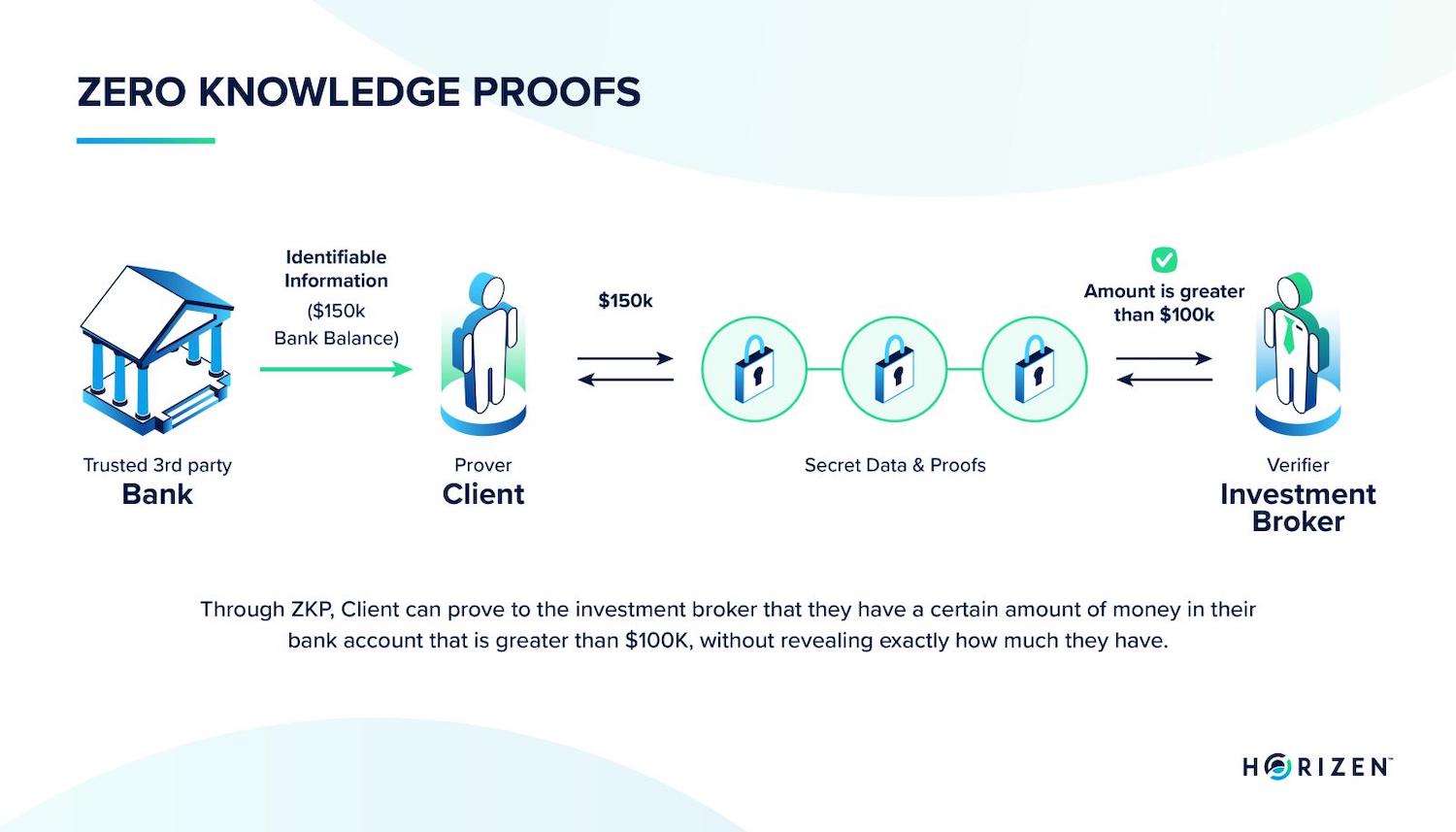
Compliance Implications
For legal and regulatory audiences, the primary benefit of ZK-SNARKs is the reduction of data fiduciary duty. When an enterprise does not hold the raw data, it cannot be held responsible for its misuse in the event of a breach. This aligns with the concept of privacy by design, where data protection is integrated into the system architecture from the outset. However, enterprises must ensure that the trusted setup for ZK-SNARKs is conducted securely and that the underlying cryptographic standards, such as those published by ZKProof, are current and audited.
The shift to ZK-based identity also impacts consent management. Users can grant granular consent for specific attributes rather than broad data sharing. This supports the principle of purpose limitation, ensuring that data is used only for the specific, explicit, and legitimate purposes for which it was collected. As 2026 regulations tighten around digital identity, ZK-SNARKs provide a technical foundation for compliance that is both robust and user-centric.
Aligning zero-knowledge proofs with GDPR mandates
The General Data Protection Regulation (GDPR) establishes a framework where data handling must be lawful, fair, and transparent. For enterprises, the tension often arises between the need to verify user attributes and the obligation to limit data exposure. Zero-knowledge proofs (ZKPs) offer a cryptographic mechanism to resolve this tension by allowing one party to prove the validity of a statement without revealing any information beyond the statement's own validity. This capability directly supports the principles of data minimization and purpose limitation, which are foundational to GDPR compliance.
Verifying age without storing birth dates
Article 5(1)(c) of the GDPR mandates data minimization, requiring that personal data be adequate, relevant, and limited to what is necessary for the purposes for which they are processed. Traditional compliance often involves storing birth dates to verify age restrictions, creating a persistent record of sensitive personal data. ZK-SNARKs (Zero-Knowledge Succinct Non-Interactive Arguments of Knowledge) enable a system to verify that a user is over 18 without accessing or storing their actual date of birth. The cryptographic circuit proves the predicate "age > 18" is true, satisfying regulatory requirements while eliminating the storage of the underlying personal identifier.
Proving eligibility without exposing identity
Article 25 of the GDPR requires data protection by design and by default. This means that technical and organizational measures must ensure that, by default, only personal data necessary for each specific purpose is processed. In scenarios requiring proof of eligibility, such as verifying residency or professional credentials, ZKPs allow an enterprise to confirm a user meets specific criteria without exposing their full identity or address history. This aligns with purpose limitation (Article 5(1)(b)), ensuring that data collected for one specific verification task is not inadvertently retained or used for unrelated profiling activities.
Reducing liability through cryptographic separation
By separating the verification of facts from the storage of personal data, enterprises can significantly reduce their attack surface and liability under the GDPR. If a breach occurs, the exposed data consists only of non-sensitive proof statements rather than raw personal identifiers. This structural separation supports the accountability principle (Article 5(2)), demonstrating that the controller has implemented appropriate technical measures to protect personal data. ZKProof standards provide the rigorous mathematical foundations necessary to ensure these proofs are sound and verifiable, offering a defensible technical basis for compliance audits.
-
Verify that ZK circuits do not leak intermediate personal data during proof generation.
-
Ensure proof verification occurs on-chain or in a trusted execution environment without storing raw inputs.
-
Document the cryptographic assumptions and security parameters used in the ZKP implementation.
-
Conduct regular audits of the circuit logic to confirm it strictly enforces data minimization principles.
Standardization efforts in 2026
The transition from experimental cryptography to enterprise-grade compliance hinges on standardized protocols. In 2026, the ZKProof initiative remains the primary academic and industry body establishing rigorous specifications for zero-knowledge proof systems. Its standards ensure that cryptographic circuits, particularly ZK-SNARKs, are verified against consistent mathematical properties, allowing regulated entities to audit implementations with confidence.
Adherence to these standards is not merely a technical preference but a compliance necessity. By following ZKProof specifications, enterprises align their data minimization and purpose limitation strategies with recognized cryptographic baselines. This alignment reduces the legal ambiguity surrounding proof generation, ensuring that the underlying mathematics withstands regulatory scrutiny. Without such standardization, the fragmentation of proprietary proof systems would create unacceptable gaps in audit trails.
Beyond ZKProof, broader cybersecurity frameworks are beginning to integrate zero-knowledge methodologies. Recent academic discourse, including publications in Springer’s Cybersecurity journal, highlights the evolution toward Trusted Zero-Knowledge Remote Knowledge Proofs (TRZKP). These non-interactive proof structures allow entities to publish verifiable claims without exposing underlying data, a critical feature for cross-border data transfers under strict privacy regimes.
The convergence of these standardization efforts creates a unified landscape for enterprise adoption. Regulators and legal teams can reference established protocols rather than evaluating each proprietary implementation from scratch. This shift from bespoke cryptography to standardized frameworks accelerates deployment while maintaining the high-stakes security required by financial and healthcare sectors.
No comments yet. Be the first to share your thoughts!