
What zero-knowledge proofs actually do
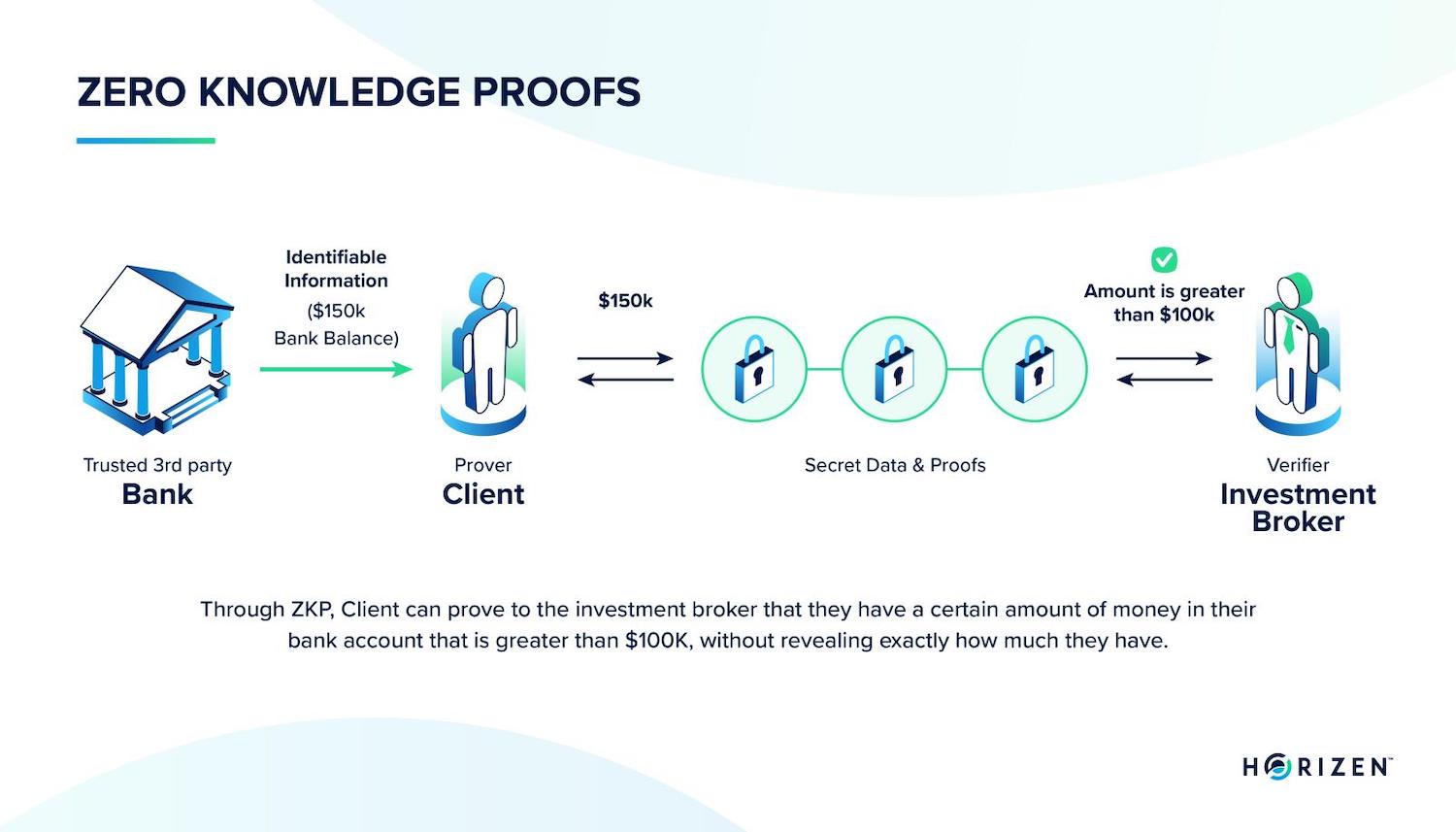
A zero-knowledge proof is a cryptographic protocol that allows one party to prove the validity of a statement without revealing the statement itself. In the standard prover-verifier model, the prover demonstrates knowledge of specific data to a verifier, who confirms the proof's authenticity without accessing the underlying information. This mechanism ensures that sensitive data remains private while still enabling trust and verification in decentralized systems.
The concept was introduced by Goldwasser, Micali, and Rackoff in their 1985 paper, The Knowledge Complexity of Interactive Proof Systems. They established that probabilistic and interactive proofs could efficiently demonstrate membership in a language without conveying any additional knowledge beyond the validity of the claim. This foundational work distinguishes zero-knowledge proofs from traditional verification methods, which often require sharing the data being verified.
In Web3 applications, this capability is critical for maintaining privacy while ensuring compliance and security. Ethereum.org describes zero-knowledge proofs as a way to prove the validity of a statement without revealing the statement itself. By leveraging this technology, blockchains can process transactions and validate state transitions without exposing user balances, identities, or transaction details to the public network.
ZK rollups versus zero-knowledge identity
Zero-knowledge proofs serve two distinct functions in Web3 infrastructure. One scales transaction throughput. The other protects personal privacy. Understanding the difference between ZK rollups and zero-knowledge identity systems is essential for evaluating their respective roles in the current market.
ZK rollups focus on data availability and execution efficiency. They bundle many transactions off-chain and submit a single validity proof to the main chain. This approach allows Ethereum to handle higher throughput without compromising security. The primary goal is scaling the network while keeping all transaction data verifiable.
Zero-knowledge identity systems, often called zk-SNARKs or zk-STARKs for credentials, focus on selective disclosure. They allow a user to prove they meet specific criteria without revealing their underlying data. For example, a user can prove they are over 21 without sharing their birthdate. This use case prioritizes privacy and data minimization over throughput.
The technical requirements for these two applications differ significantly. Rollups require high-throughput proof generation to keep gas costs low for users. Identity systems require efficient verification of complex statements without exposing sensitive attributes. The table below compares these distinct operational models.
| Metric | ZK Rollups | ZK Identity |
|---|---|---|
| Primary Goal | Scale transaction throughput | Verify credentials privately |
| Data Visibility | Public on-chain data | Private user attributes |
| Typical Use Case | DeFi transaction batching | Age verification, KYC |
| Proof Complexity | High (state transitions) | Medium (statement logic) |
Both systems rely on the same underlying cryptographic principles but apply them to different problems. Rollups optimize for speed and cost. Identity systems optimize for privacy and control. As the market matures, we will likely see more specialized tools for each use case.
Proving privacy in enterprise and finance
Enterprise adoption of zero-knowledge proofs (ZKP) is shifting from experimental pilot programs to regulated compliance frameworks. Unlike traditional blockchain transparency, which exposes all transaction data to public audit, ZKP technology allows organizations to verify data integrity without revealing the underlying sensitive information. This capability is critical for institutions subject to strict regulatory environments, including GDPR in Europe and HIPAA in the United States.
For financial institutions, this means conducting confidential transactions. Banks can validate that a client meets specific creditworthiness criteria or that a transaction does not violate sanctions lists, all while keeping the client's identity and financial history private. The NIST has identified ZKP as a primary tool within Privacy-Enhancing Cryptography (PEC), noting its ability to prove the truthfulness of a mathematical statement without disclosing the data itself [src-serp-3].
The implementation challenge lies in the computational cost of generating proofs. While ZK-SNARKs offer small proof sizes, they require a trusted setup phase that some enterprises view as a security risk. ZK-STARKs eliminate the trusted setup, offering greater transparency, but at the cost of larger proof sizes and higher verification complexity. As the industry matures, the choice between these protocols depends on the specific balance between computational efficiency and trust assumptions required by the use case.
Scaling Limits of ZK Proofs
Zero-knowledge cryptography introduces a fundamental asymmetry: generating a proof is computationally expensive, while verifying it is nearly instantaneous. This "hard work, easy check" dynamic is the engine of ZK scalability, but it also creates a bottleneck. In 2026, the primary constraint is no longer just the algorithmic complexity of the circuit, but the hardware efficiency of the prover.
Proof generation costs remain the most significant barrier to mass adoption for high-throughput applications. Generating a ZK-SNARK proof for a complex transaction can take seconds to minutes on standard CPU hardware, depending on the circuit size. While STARKs offer better quantum resistance and parallelizability, their larger proof sizes and higher computational overhead during generation present different trade-offs. The industry is currently split between optimizing for prover speed (favoring SNARKs in many rollup implementations) and verifier efficiency (where STARKs are gaining traction).
Hardware acceleration is reshaping the economics of proof generation. Specialized FPGAs and GPUs can reduce proof times by orders of magnitude compared to general-purpose CPUs. However, these accelerators often require significant capital expenditure and specialized engineering to integrate into blockchain infrastructure. The cost-benefit analysis depends heavily on the volume of transactions: high-frequency trading platforms justify the hardware investment, while smaller projects may still rely on cloud-based CPU proving services.
The latency of proof generation directly impacts user experience. For applications requiring real-time finality, the delay between transaction submission and proof availability can be a critical friction point. As the network scales, the queue for proving resources becomes a de facto bottleneck, leading to variable gas fees for proving services. This volatility introduces uncertainty into the cost structure of ZK-powered applications.
The trade-off between security assumptions and computational cost remains unresolved. SNARKs rely on trusted setups (in the case of Groth16) or complex trusted environments, while STARKs are transparent but computationally heavier. The choice between these technologies is not merely technical but strategic, influencing the long-term viability and decentralization of the underlying protocol.
Market adoption trends for ZK technology
The transition of zero-knowledge proofs (ZKPs) from theoretical cryptography to production-grade infrastructure marks a significant shift in Web3 market dynamics. Early experimental deployments have given way to robust, scalable solutions that address the fundamental trade-off between privacy and transparency. As noted by Ethereum.org, ZKPs enable the validation of statements without exposing the underlying data, a capability that is now becoming a standard requirement for institutional-grade blockchain applications.
Adoption is no longer limited to niche privacy coins. Major Layer 2 scaling solutions, such as zkSync and StarkNet, rely heavily on ZK-rollups to process transactions off-chain while maintaining security guarantees anchored to the Ethereum mainnet. This architectural choice reduces gas fees and increases throughput, making ZK technology a critical component for high-frequency DeFi applications and enterprise-grade data verification. The market is increasingly rewarding projects that integrate ZKPs not just as a privacy feature, but as a scalability mechanism.
Financial markets are beginning to reflect this technological maturity. The valuation of ZK-focused protocols and related infrastructure tokens often correlates with technical breakthroughs in proof generation speed and cost. Investors and developers are prioritizing projects that demonstrate real-world utility in data verification, identity management, and confidential computing. The following chart illustrates the technical market sentiment surrounding Ethereum (ETH), which serves as the primary settlement layer for most ZK-rollup deployments.
No comments yet. Be the first to share your thoughts!