Integrating TFHE with ZK-SNARKs for Private On-Chain Computations

In the shadowed corridors of blockchain innovation, where data privacy clashes with computational demands, the fusion of TFHE and ZK-SNARKs stands as a beacon for private on-chain computations. As a long-term investor eyeing sustainable Web3 strategies, I’ve watched privacy technologies mature from niche experiments to indispensable tools. TFHE, a flavor of fully homomorphic encryption, lets us crunch numbers on ciphertexts without decryption, while ZK-SNARKs vouch for computation integrity sans revealing inputs. Together, they promise confidential smart contracts that could redefine global trade protocols, shielding sensitive commodities data much like historical trade ledgers once hid merchant secrets.


TFHE’s Homomorphic Magic Meets ZK-SNARK Succinctness
TFHE’s strength lies in its ability to perform arbitrary computations on encrypted data, a feat rooted in lattice-based cryptography. Unlike earlier FHE schemes bogged down by noise growth, TFHE’s bootstrapping technique refreshes ciphertexts efficiently, enabling deep circuits. Yet, on-chain deployment demands trustless verification. Enter ZK-SNARKs: succinct, non-interactive proofs that compress massive computations into tiny verifiable snippets. Historically, Zcash pioneered ZK-SNARKs for shielded transactions, proving privacy’s scalability. Today, this integration tackles FHE ZK proofs blockchain challenges head-on.
From an investor’s lens, this pairing echoes the patient build-up in commodities markets. Just as encrypted ledgers protected spice trade routes centuries ago, homomorphic encryption ZK fortifies DeFi against prying eyes, fostering enduring confidentiality.
Bootstrapping Under Proof: The Core Integration Mechanism
The linchpin is proving TFHE’s bootstrapping correctly via ZK-SNARKs. Bootstrapping counters noise accumulation, but it’s computationally heavy and opaque to verifiers. Recent breakthroughs, like those using Plonky2, generate SNARKs attesting to flawless execution. This creates a hybrid system: compute homomorphically off-chain or via accelerators, then post a ZK proof on-chain for settlement. No data leaks, full verifiability.
Strategically, this shifts privacy from optional to protocol-enforced. Imagine blockchains where consensus demands ZK proofs for all transactions, embedding TFHE ZK-SNARKs integration at the core. It’s not hype; it’s the architecture for macro confidential computing, where enterprises process trade data without exposure.
Navigating Performance Pitfalls in On-Chain FHE
Pure FHE on-chain? Latency kills it. Homomorphic ops devour cycles, with bootstraps rivaling entire block validations. Enter optimizations: specialized hardware accelerators slashing TFHE runtime, paired with ZK’s succinct checks. Protocol-level ZK verification in consensus clients further streamlines, turning privacy into a lightweight layer rather than a bolt-on.
Reflecting on 18 years in markets, I’ve seen tech fads fade. This private on-chain computation stack endures because it balances efficiency with ironclad privacy, much like diversified portfolios weather volatility. Developers now circuit-write for hybrid flows, verifying FHE gates via SNARKs, paving Web3’s confidential future.
Yet hurdles persist: proof generation overhead, circuit complexity for advanced TFHE ops. Historical parallels abound; early elliptic curve crypto faced similar scalability gripes before optimization waves hit.
Progress demands ingenuity. Proof generation, often the bottleneck, benefits from recursive SNARKs and hardware like GPUs, compressing verification gas costs to Ethereum-friendly levels. Circuit design evolves too; tools like Circom and Plonky3 abstract TFHE gates into provable primitives, democratizing confidential smart contracts. I’ve invested in projects where such optimizations turned theoretical promise into deployable reality, mirroring how commodities traders layered hedges over volatile routes for steady gains.
Circom Circuit Example: Private Multiplication for SNARK and FHE Integration
To adhere to ZK proof standards in SNARK development, Circom offers a domain-specific language for crafting arithmetic circuits. Strategically, we start with a private multiplication circuit—a fundamental building block for verifying FHE operations like those in TFHE, where multiplications under encryption are common.
```circom
pragma circom 2.0.0;

template PrivateMultiplier() {
    signal input a;  // Private input, e.g., TFHE-decrypted value
    signal input b;  // Private input
    signal output c;

    c <== a * b;
}

component main {public [c]} = PrivateMultiplier();
```
This circuit compiles to R1CS constraints, generating a SNARK proof that confirms the multiplication without exposing inputs. It positions us to integrate TFHE-evaluated ciphertexts, decrypted privately off-chain, for seamless on-chain verification of confidential computations.
Real-World Pilots: From Labs to Ledgers
Projects like Fhenix pioneer on-chain FHE with TFHE, leveraging ZK proofs for bootstrapping integrity. Their hardware accelerators cut computation times dramatically, enabling auctions or prediction markets where bids stay encrypted until reveal. Zama's concrete ML frameworks extend this to machine learning on ciphertexts, verified via SNARKs - think DeFi oracles processing private data streams without leaks. Chainscore's protocol-level ZK enforcement envisions blockchains where every tx bundles a proof, baking in TFHE ZK-SNARKs integration from genesis.
Strategically, this stack suits macro applications: confidential commodities exchanges, where prices and volumes compute homomorphically, settled publicly via proofs. Historical trade houses thrived on such opacity; modern Web3 revives it digitally, yielding privacy premiums in volatile markets.
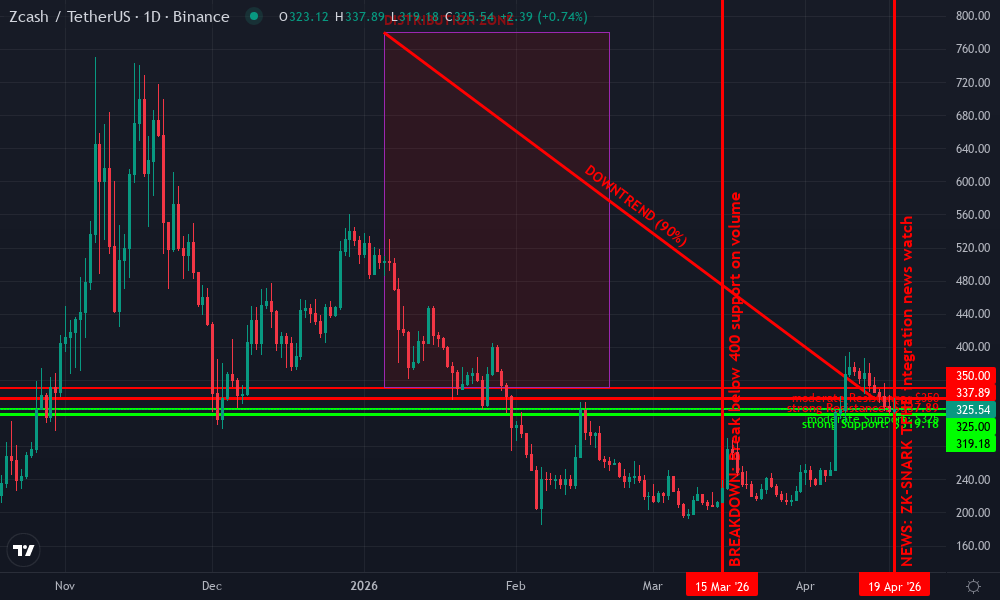
Zcash Technical Analysis Chart
Analysis by Market Analyst | Symbol: BINANCE:ZECUSDT | Interval: 1D | Drawings: 8
Technical Analysis Summary
As a balanced technical analyst, start by drawing a primary downtrend line connecting the swing high near 780 on 2026-01-05 to the recent swing high at 337.89 on 2026-04-15, highlighting the dominant bearish channel. Add horizontal lines for key support at 319.18 (today's low) and 325.80 (current price zone), and resistance at 337.89 and 350 (prior consolidation base). Use fib retracement from the January low around 350 to February high 480 for potential retracement levels. Mark a rectangle for recent consolidation from 2026-03-20 to 2026-04-18 between 325-340. Add arrow markers for volume spikes on down days and callouts for MACD bearish divergence signals. Vertical line at 2026-04-19 for upcoming ZK-SNARK news impact watch.
Risk Assessment: medium
Analysis: Clear downtrend but oversold with positive fundamentals; medium risk for counter-trend plays
Market Analyst's Recommendation: Consider long on 325 hold with stop below 319, target 350; monitor volume for reversal confirmation
Key Support & Resistance Levels
📈 Support Levels:
-
$319.18 - Recent daily low, strong volume test
strong -
$325 - Current price zone, prior swing
moderate
📉 Resistance Levels:
-
$337.89 - Recent high, channel resistance
strong -
$350 - April consolidation top
moderate
Trading Zones (medium risk tolerance)
🎯 Entry Zones:
-
$325 - Bounce from support with ZK news catalyst
medium risk -
$319 - Break and retest of low for aggressive long
high risk
🚪 Exit Zones:
-
$350 - First resistance target
💰 profit target -
$337.89 - Trail stop at prior high
💰 profit target -
$310 - Below support invalidation
🛡️ stop loss
Technical Indicators Analysis
📊 Volume Analysis:
Pattern: High volume on breakdowns, low on bounces - bearish confirmation
Volume spikes align with down moves, recent drying up suggests exhaustion
📈 MACD Analysis:
Signal: Bearish divergence and line below signal
MACD histogram contracting but negative, watch for bullish cross
Applied TradingView Drawing Utilities
This chart analysis utilizes the following professional drawing tools:
Disclaimer: This technical analysis by Market Analyst is for educational purposes only and should not be considered as financial advice.
Trading involves risk, and you should always do your own research before making investment decisions.
Past performance does not guarantee future results. The analysis reflects the author's personal methodology and risk tolerance (medium).
Enterprise Horizons: Scalable Privacy for Global Trade
Enterprises eye this for supply chain ledgers, where ZK-verified FHE processes IoT sensor data on encrypted payloads. No more selective disclosure risks; full computations attest correctness. In DeFi, yield aggregators optimize private portfolios, proofs ensuring fair math. Bitcoin's sCrypt integrations hint at cross-chain potential, porting ZK-SNARKs to UTXO models for hybrid privacy.
From my vantage, the true edge lies in composability. ZK-SNARKs succinctness lets FHE stack atop rollups, slashing L1 load while preserving confidentiality. zkRollups, already scaling Ethereum, amplify with homomorphic pre-processing - private state transitions at warp speed.
This fusion isn't mere tech; it's a strategic moat for Web3's next era. By wedding TFHE's computational depth to ZK-SNARKs' verifiability, we craft blockchains as unbreachable vaults for sensitive ops. Commodities markets, long my focus, stand to gain most - encrypted trades flowing seamlessly, privacy yielding those enduring returns I always champion.