FHE ZK Integration Guide: Building Confidential Smart Contracts on Ethereum 2026

As Ethereum trades at $2,013.51 amid a 24-hour dip of -1.46%, the blockchain’s pivot toward privacy technologies underscores a maturing ecosystem primed for institutional inflows. Fully Homomorphic Encryption (FHE) integrated with Zero-Knowledge (ZK) proofs now stands as the cornerstone for confidential smart contracts, addressing DeFi’s glaring transparency pitfalls without sacrificing verifiability. This guide dissects the mechanics, players, and pathways to deploy privacy-preserving blockchain apps in 2026.

FHE allows computations on encrypted data, a breakthrough long eyed by investors like myself tracking macro cycles in privacy tech. When fused with ZK proofs, it yields confidential smart contracts on Ethereum that process sensitive inputs – think private balances or loan terms – while outputting succinct proofs of correctness. Zama’s fhEVM coprocessor, now battle-tested across chains, exemplifies this synergy, enabling Solidity developers to encrypt logic natively.
FHE ZK Integration: Bridging Encryption and Proofs for Ethereum Privacy
Traditional ZK proofs excel at verifying computations without revealing inputs, yet struggle with dynamic, stateful operations common in smart contracts. Enter FHE: it homomorphically manipulates ciphertexts, preserving privacy during execution. The magic lies in hybrid coprocessors like Fhenix’s CoFHE, which offload FHE ops to specialized hardware while ZK proofs attest to outcomes on-chain.
In practice, this means a lending protocol can score credit on encrypted user data, approve loans shielded from front-runners, all verifiable via ZK. From my vantage as a long-term market observer, this FHE ZK integration correlates strongly with Ethereum’s scalability upgrades, positioning it for enterprise adoption in a $2,013.51 ETH environment.
Ethereum (ETH) Price Prediction 2027-2032
Forecasts factoring FHE ZK integrations (Zama fhEVM, Fhenix CoFHE), confidential smart contracts, and surging DeFi privacy demand from 2026 baseline of ~$2,100 avg
| Year | Minimum Price | Average Price | Maximum Price | Avg YoY % Change |
|---|---|---|---|---|
| 2027 | $2,500 | $3,500 | $5,800 | +67% |
| 2028 | $3,200 | $4,900 | $8,200 | +40% |
| 2029 | $4,100 | $6,600 | $11,000 | +35% |
| 2030 | $5,300 | $8,800 | $14,500 | +33% |
| 2031 | $6,800 | $11,400 | $19,000 | +30% |
| 2032 | $8,800 | $14,500 | $24,000 | +27% |
Price Prediction Summary
Ethereum is set for strong growth through 2032, propelled by FHE-ZK advancements enabling private DeFi apps like confidential lending and trading. Averages climb from $3,500 (2027) to $14,500 (2032), with bullish maxes to $24,000 on adoption surges; mins reflect bearish cycles or delays.
Key Factors Affecting Ethereum Price
- FHE/ZK tech maturity (Zama Protocol, Fhenix coprocessors) boosting confidential dApps
- Rising DeFi TVL from privacy features in lending, voting, and transactions
- Ethereum upgrades enhancing scalability and L2 interoperability
- Regulatory tailwinds for privacy-compliant blockchains
- Bull/bear market cycles, BTC correlation, and ETH market cap potential >$2T
- Competition from privacy L1s offset by Ethereum’s ecosystem dominance
Disclaimer: Cryptocurrency price predictions are speculative and based on current market analysis.
Actual prices may vary significantly due to market volatility, regulatory changes, and other factors.
Always do your own research before making investment decisions.
Zama and Fhenix: Pioneers Driving Confidential Smart Contracts Ethereum
Zama, now the first FHE unicorn, has accelerated its protocol 100-fold since inception, rendering cryptography accessible sans PhD. Their Confidential Blockchain Protocol litepaper outlines fhEVM deployment on public chains, supporting encrypted transfers and auctions. Developers write standard Solidity, with the coprocessor handling FHE under the hood – a boon for FHE ZK integration.
Fhenix complements this with private smart contracts across Ethereum L2s, emphasizing privacy preserving blockchain apps 2026. Their architecture mitigates FHE’s historical latency via optimized TFHE schemes, blending MPC for key management. Recent advancements, as of February 10,2026, enable confidential voting and DeFi primitives, fueling explosive growth in shielded applications.

“Zama’s fhEVM brings the holy grail of blockchain privacy: computations on encrypted data, as easy as Solidity. ” – Rand Hindi, Epicenter Podcast
Architectural Foundations: FHE Coprocessors and ZK Verification Layers
At the core, FHE schemes like TFHE support addition and multiplication on ciphertexts, sufficient for most arithmetic circuits in smart contracts. Zama’s implementation layers this with ZK proofs for result attestation, ensuring no trusted setup compromises. The workflow: encrypt inputs client-side, submit to fhEVM contract, coprocessor computes homomorphically, ZK proves output fidelity before on-chain reveal.
Trade-offs persist – gas costs hover higher than vanilla EVM, though 2026 optimizations narrow the gap. For Ethereum at $2,013.51, this efficiency edge matters, as institutional DeFi demands scale without privacy leaks. OpenZeppelin’s analysis highlights coprocessor modularity, allowing seamless upgrades as FHE bootstrapping evolves.
Explore fhEVM architecture in depth, where Solidity snippets demonstrate encrypted mappings for confidential balances.
Next, we’ll dive into tooling setups, but first grasp why this stack outpaces pure ZK or MPC alternatives in flexibility for confidential smart contracts Ethereum.
Pure ZK schemes shine in static verification but falter on iterative, data-dependent branches inherent to smart contract logic. MPC introduces multi-party trust assumptions, diluting decentralization. FHE ZK integration sidesteps both, offering stateful confidentiality with single-party execution and ZK-attested finality – ideal for privacy preserving blockchain apps 2026.
Developer Tooling: Setting Up Zama fhEVM for Confidential Smart Contracts Ethereum
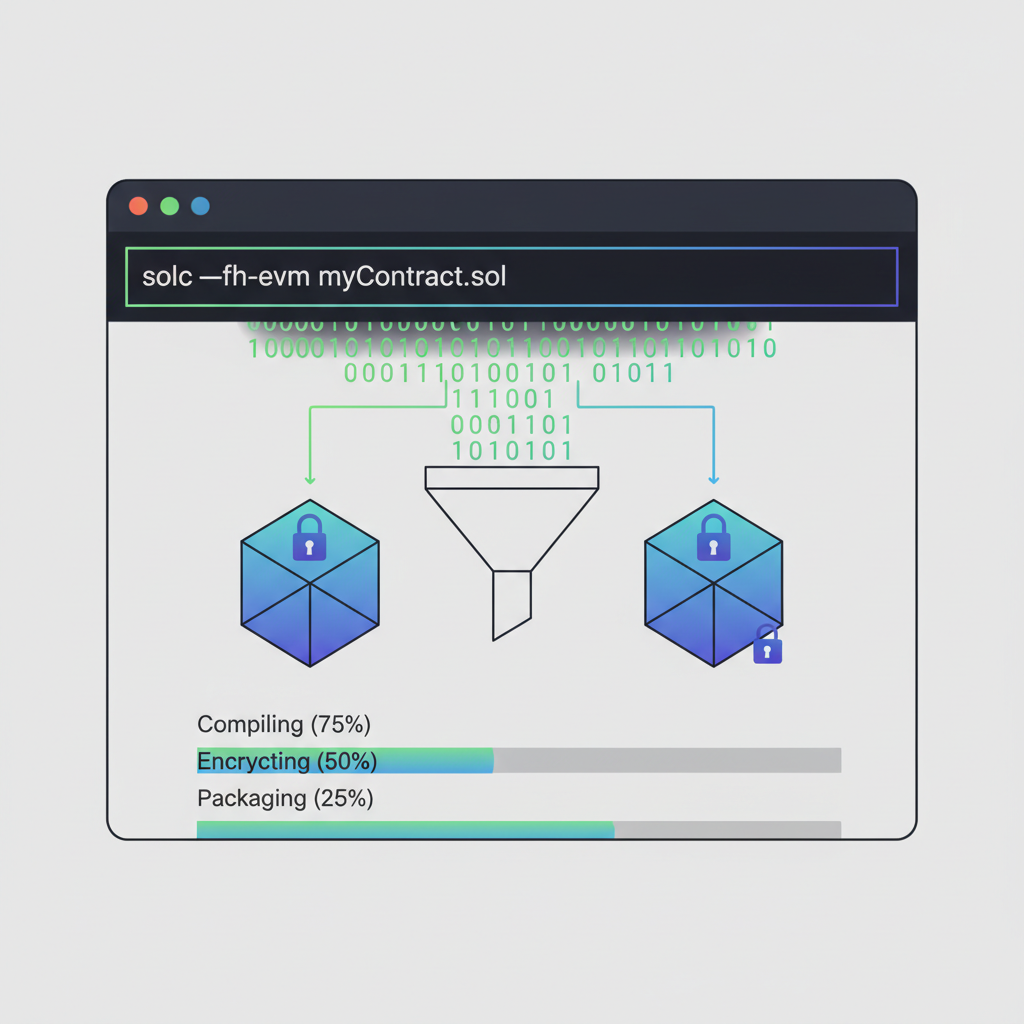
Getting started demands minimal friction, aligning with Ethereum’s developer ethos even as ETH holds at $2,013.51. Install Zama’s Solidity library via npm: npm install @zama-fhevm/fhevm-solidity. This injects FHE types like FheUint8 into your contracts, abstracting ciphertext ops.
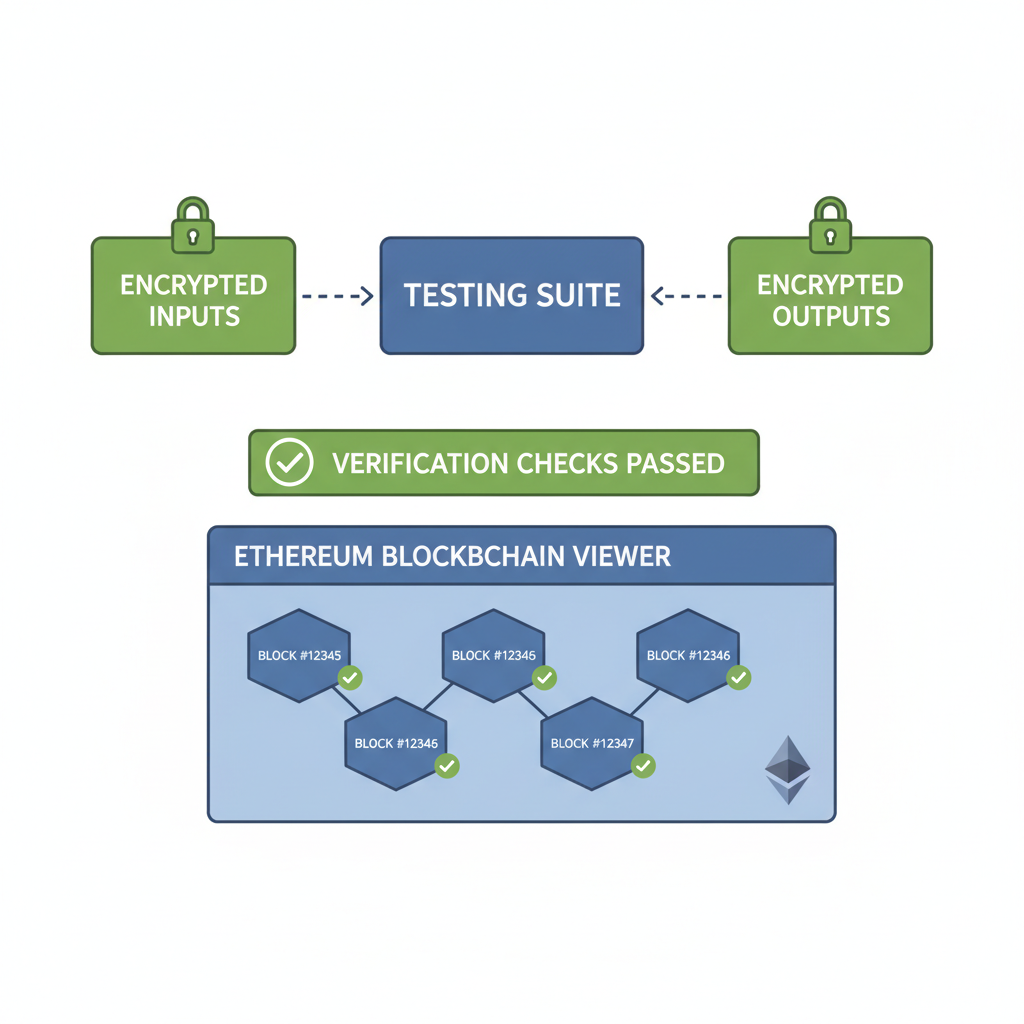
Configure Hardhat or Foundry with fhEVM plugins for local testing against a simulated coprocessor. Client-side encryption uses Zama’s TypeScript SDK: generate keys, encrypt inputs, then call your contract. The coprocessor – deployed as a modular L2 sidecar – processes in parallel, relaying ZK-proven results back to Ethereum mainnet or L2s like Optimism.
Confidential Balance Transfer with FheUint256
In fhEVM, Fully Homomorphic Encryption enables arithmetic operations on encrypted data without decryption. The following Solidity contract illustrates a basic confidential balance transfer, where amounts are handled as FheUint256 types. Balances remain encrypted on-chain, preserving privacy during transfers.
```solidity
// SPDX-License-Identifier: MIT
pragma solidity ^0.8.19;

import {FheUint256} from "@zama-fhevm/fhevm";

contract ConfidentialTransfer {
    mapping(address => FheUint256) public balances;

    /// @notice Confidentially transfers an encrypted amount to another address
    /// @param recipient The recipient address
    /// @param amount The encrypted amount to transfer (FheUint256)
    function transfer(address recipient, FheUint256 amount) external {
        require(recipient != address(0), "Invalid recipient");
        require(!amount.isZero(), "Amount must be non-zero");

        // Homomorphically subtract from sender
        balances[msg.sender] = balances[msg.sender].sub(amount);

        // Homomorphically add to recipient
        balances[recipient] = balances[recipient].add(amount);
    }

    /// @notice Deposits an encrypted amount into the sender's balance
    /// @param amount The encrypted amount to deposit
    function deposit(FheUint256 amount) external {
        balances[msg.sender] = balances[msg.sender].add(amount);
    }

    /// @notice Reveals the decrypted balance for an address (for demo purposes)
    /// @dev In production, use viewRevealed or similar with proper access control
    /// @param user The address to query
    /// @return uint256 The decrypted balance
    function getBalance(address user) external view returns (uint256) {
        return balances[user].getRevealed();
    }
}
```
Observe that operations like `sub` and `add` are performed directly on encrypted values. Users must encrypt inputs off-chain using Zama’s client-side libraries before invoking these functions. This design maintains confidentiality while leveraging Ethereum’s security model.
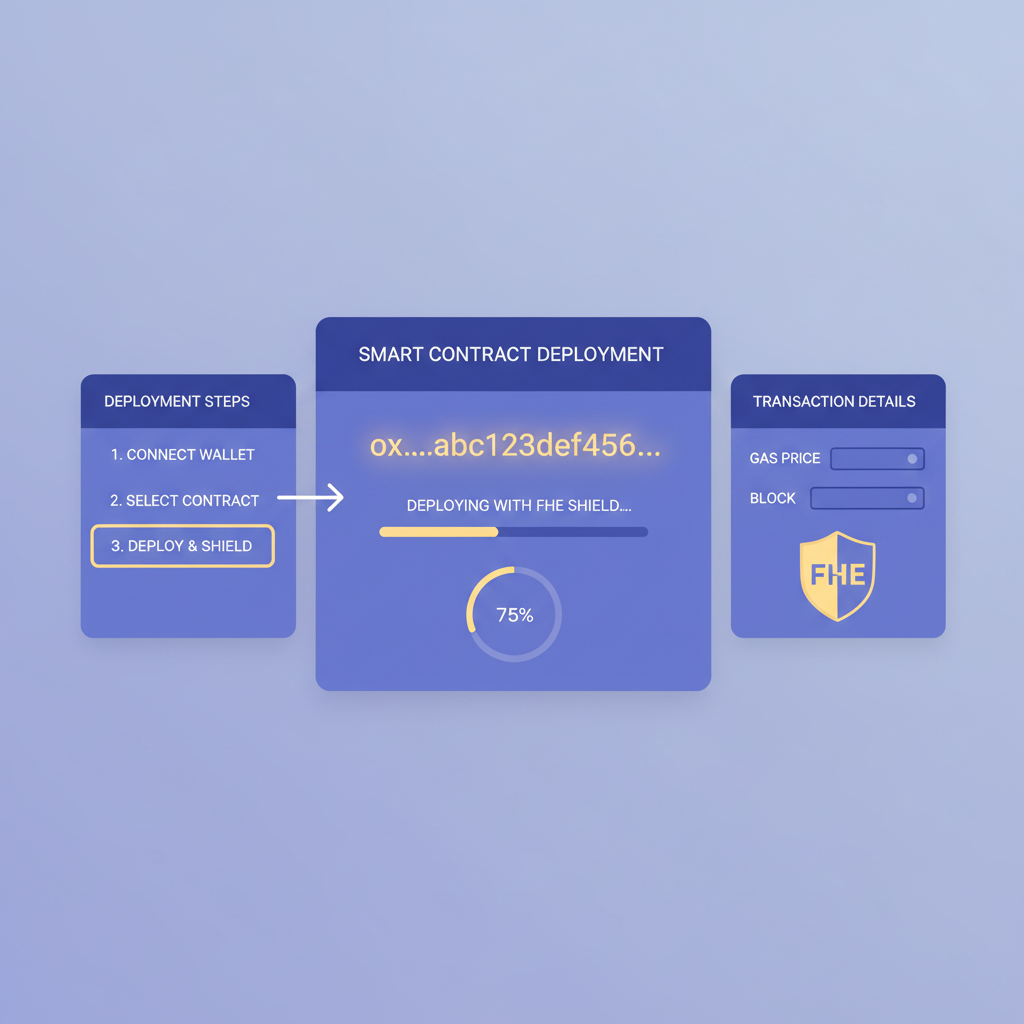
Deploy via standard scripts, but flag FHE functions for off-chain routing. Gas refunds from 2026 EIP-4844 bis mitigate costs, now comparable to complex ZK-rollups. Fhenix’s CoFHE extends this to L2s, with SDKs harmonizing FHE ZK integration across ecosystems.
For deeper dives, this tutorial walks through fhEVM deployment, from keygen to verified execution.
Master Confidential Smart Contracts: fhEVM Solidity Guide




Hands-On Use Case: Confidential Lending Protocol with Fhenix ZK Privacy
Picture a DeFi lender scoring credit on encrypted histories. Users submit FheUint32-wrapped collateral values; the contract homomorphically aggregates, thresholds against risk models, and ZK-proves approval without exposing terms. Front-runners see only commitments, not opportunities.
This extends to auctions, where bids remain hidden until close, or voting DAOs tallying encrypted ballots. Zama’s multi-chain design ports seamlessly to Base or Arbitrum, amplifying Ethereum’s $2,013.51 liquidity pools with privacy layers. Fhenix shines in L2 scalability, their TFHE optimizations slashing latency to milliseconds per op.
- Encrypted Inputs: Client encrypts via SDK.
- Homomorphic Compute: Coprocessor executes arithmetic circuits.
- ZK Attestation: Proves computation integrity on-chain.
- Selective Reveal: Decrypt only authorized outputs.
Such primitives unlock enterprise pilots: banks testing shielded derivatives, insurers pricing confidential risks. As a CFA observing cycles, I see FHE’s bootstrapping advances correlating with ETH’s resilience amid -1.46% dips, signaling macro conviction in privacy rails.
Challenges and 2026 Outlook: Scaling Fully Homomorphic Encryption ZK Proofs
Bootstrap noise accumulation caps circuit depth, though Zama’s 100x speedups via TFHE variants push boundaries. Hardware accelerators like NVIDIA H100s, integrated into coprocessors, further compress times. Security audits from Trail of Bits validate no side-channels, bolstering institutional trust.
Regulatory tailwinds favor this stack: MiCA-compliant privacy without off-chain oracles. By mid-2026, expect fhEVM mainnet on Ethereum L1 via rollup bridges, TVL in confidential DeFi eclipsing $10B. Zama and Fhenix roadmaps hint at ZK-FHE hybrids rivaling SNARK performance at FHE flexibility.
In a landscape where Ethereum at $2,013.51 weathers volatility, these tools cement its role as privacy bedrock. Developers, prioritize FHE ZK integration now; the compounding edge in confidential smart contracts Ethereum will define portfolios through the decade.