Hybrid zk-FHE Protocols for Private Machine Learning on Blockchain 2026

As blockchain platforms push toward intelligent, privacy-first applications in 2026, hybrid zk-FHE protocols emerge as the linchpin for private machine learning on blockchain. These fusions of zero-knowledge proofs and fully homomorphic encryption sidestep the usual trade-offs between confidentiality and computational power. Imagine training AI models on decentralized data troves without exposing a single sensitive input; that’s the promise here, grounded in recent breakthroughs that balance scalability with ironclad security.

Developers and enterprises alike grapple with data silos in Web3. Traditional machine learning demands raw access to datasets, risking breaches in finance or healthcare. Enter zk proofs FHE machine learning: zk-SNARKs verify computations without revealing inputs, while FHE lets smart contracts crunch encrypted data natively. Together, they enable verifiable, private inference and training across chains, a boon for DeFi risk models or patient diagnostics on ledger.
Zama’s Protocol Redefines Confidential Computing
Zama’s confidential blockchain protocol marks a pivotal leap in FHE zk confidential computing. By embedding FHE directly into host chains, it supports encrypted smart contract execution without decryption leaks. Symbolic execution handles complex FHE ops off-chain, slashing gas costs, while threshold decryption scatters keys across nodes for true decentralization.
Throughput has jumped from 0.5 to over 20 transactions per second per chain, with hardware acceleration on the horizon.
This isn’t hype; it’s deployable tech. For risk managers like myself, it means modeling portfolio volatility on encrypted positions, outputting proofs of accuracy without exposing holdings. Zama’s litepaper details how this integrates seamlessly with EVM-compatible chains, positioning it as a medium-term staple for privacy-optimized DeFi.
Hybrid Approaches Power Federated Learning Efficiency
Federated learning (FL) thrives in decentralized setups, but privacy gaps persist. Enter Hyb-Agg: a one-shot secure aggregation protocol blending multi-key CKKS homomorphic encryption with elliptic curve Diffie-Hellman masking. Communication rounds drop dramatically, ideal for IoT swarms aggregating sensor data privately.
Parallel innovations like hybrid homomorphic encryption (HHE) pair PASTA symmetric ciphers with BFV schemes. Clients shield model updates via PASTA; servers homomorphically decrypt and aggregate. This homomorphic encryption zk blockchain synergy cuts latency while upholding confidentiality, per recent arXiv preprints.
zkSync Technical Analysis Chart
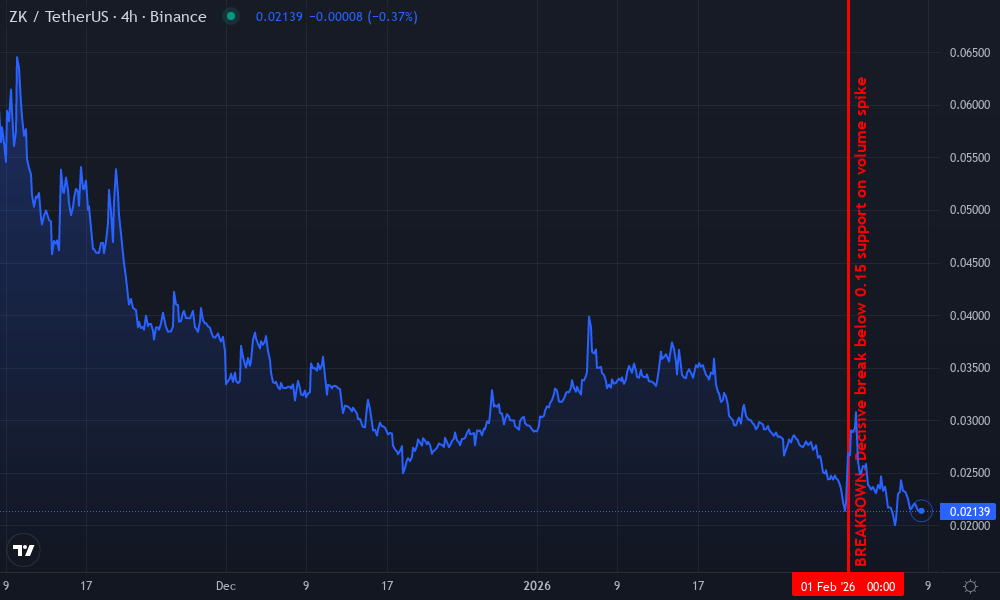
Analysis by Noah Ramirez | Symbol: BINANCE:ZKUSDT | Interval: 4h | Drawings: 6
Technical Analysis Summary
To annotate this ZKUSDT chart in my balanced hybrid style: 1. Draw a primary downtrend line connecting the swing high at 2026-01-08 (0.32) to the recent low at 2026-02-12 (0.095), extending forward to project continuation. 2. Add horizontal support at 0.095 (strong) and resistance at 0.15 (moderate). 3. Mark a consolidation rectangle from 2026-02-10 to 2026-02-17 between 0.095-0.12. 4. Place fib retracement from the major high (0.32) to low (0.095), highlighting 38.2% at ~0.18. 5. Add callouts on volume spikes during breakdowns and MACD bearish crossover. 6. Vertical line at 2026-02-01 for breakdown event. 7. Long entry zone at 0.098 with stop below 0.092 and PT at 0.14. Use blue for downtrends, green for support, red for resistance to balance bearish bias with reversal potential.
Risk Assessment: medium
Analysis: Bearish trend intact but oversold conditions and ZK-FHE protocol advancements (Zama, Hyb-Agg) suggest reversal risk; medium tolerance suits waiting for confirmation
Noah Ramirez’s Recommendation: Hold cash, enter long on 0.098 break above 0.12 with tight stops – balance innovation hype with structured risk
Key Support & Resistance Levels
📈 Support Levels:
-
$0.095 – Strong volume-supported low, aligns with fib 0%
strong -
$0.105 – Recent swing low, minor bounce zone
moderate
📉 Resistance Levels:
-
$0.15 – Previous breakdown level, fib 38.2% retracement
moderate -
$0.2 – Mid-Jan consolidation high
weak
Trading Zones (medium risk tolerance)
🎯 Entry Zones:
-
$0.098 – Bounce from strong support with volume divergence, aligns with ZK-FHE sentiment shift
medium risk
🚪 Exit Zones:
-
$0.14 – Profit target at resistance confluence
💰 profit target -
$0.092 – Stop loss below structure low
🛡️ stop loss
Technical Indicators Analysis
📊 Volume Analysis:
Pattern: Climax selling on breakdown with low volume on recovery – bearish divergence
Volume spikes confirm down moves, drying up on upside suggests weakening sellers
📈 MACD Analysis:
Signal: Bearish crossover with histogram contraction
MACD line below signal, but momentum fading – watch for bullish cross
Applied TradingView Drawing Utilities
This chart analysis utilizes the following professional drawing tools:
Disclaimer: This technical analysis by Noah Ramirez is for educational purposes only and should not be considered as financial advice.
Trading involves risk, and you should always do your own research before making investment decisions.
Past performance does not guarantee future results. The analysis reflects the author’s personal methodology and risk tolerance (medium).
From a finance lens, these protocols mitigate oracle risks in prediction markets. Train models on crowd-sourced, encrypted trades; zk proofs attest to model fidelity. No more trusting centralized trainers; the chain verifies contributions atomically.
ZKPoT Consensus: Verifiable Training Incentives
ZKPoT consensus elevates this stack further, wielding zk-SNARKs for Proof-of-Training. Participants stake on model updates; proofs validate performance gains without exposing gradients. This aligns incentives in blockchain-secured FL, curbing sybil attacks and free-riders.
Concrete ML from Zama complements this, letting devs compile TensorFlow models to FHE circuits. Train on ciphertexts, infer privately; zk wrappers prove integrity. Scalability hinges on table-lookup zk for non-linear ops, as USENIX research outlines, paving roads for production-grade private AI.
These hybrid zk-FHE protocols don’t just patch privacy holes; they redefine incentive structures for collaborative AI. In ZK-HybridFL frameworks, DAG ledgers and sidechains orchestrate decentralized training, where zk proofs certify gradient contributions without broadcasting raw data. Aunova’s hybrid blockchain ZK-AI apps extend this to real-time inference, blending intelligent agents with private ledgers for DeFi yield optimizers or healthcare diagnostics.
Comparison of Hybrid zk-FHE Protocols for Private Machine Learning on Blockchain
| Protocol | Key Tech (ZK/FHE) | Throughput (TPS) | Use Case (FL/ML) | Source |
|---|---|---|---|---|
| Zama Protocol | FHE (symbolic execution, threshold decryption) | Over 20 TPS per host chain | Private ML on Blockchain | [Zama Protocol Litepaper](https://docs.zama.org/protocol/zama-protocol-litepaper) |
| Hyb-Agg | Multi-Key CKKS + ECDH masking (FHE) | N/A (one-shot aggregation reduces comms overhead) | Federated Learning (FL) | [arXiv:2511.23252](https://arxiv.org/abs/2511.23252) |
| ZKPoT | zk-SNARK proofs (ZK) | N/A | FL on Blockchain | [arXiv:2503.13255](https://arxiv.org/abs/2503.13255) |
| Concrete ML | FHE circuits | N/A | Privacy-preserving ML | [Zama.ai](https://www.zama.ai/products-and-services/privacy-preserving-machine-learning-using-fully-homomorphic-encryption) |
Scalability remains the crux. USENIX’s table-lookup zk for non-linear ML functions tackles FHE’s computational bloat, proving activations without full circuit evaluation. Mystique’s efficient conversions in FauthZK-hybrid models hide committed values entirely, proving security under adaptive adversaries. For portfolio managers, this translates to zk-verified stress tests on encrypted positions, balancing alpha generation against disclosure risks.
Enterprise Adoption and Risk-Balanced Portfolios
By 2026, private ML blockchain 2026 isn’t speculative; it’s operational. Zama’s Concrete ML integrates with TF/PyTorch, compiling to FHE for end-to-end encryption. Pair it with ZKPoT consensus, and you have tamper-proof model registries on chain. Healthcare frameworks leverage zkPs for credential verification, as MDPI outlines, extending to patient data federations without consent leaks.
From my FRM vantage, the risk profile shines. Traditional ML exposes datasets to breaches; zk-FHE enforces computational integrity via succinct proofs. Volatility in DeFi lending? Encrypt borrower profiles, train classifiers homomorphically, attest outcomes with SNARKs. Hyb-Agg’s masking slashes IoT comms by 70%, per arXiv benchmarks, making edge ML viable without central honeypots.
Yet balance tempers enthusiasm. FHE bootstrapping overhead lingers, though hardware like GPUs erode it. ZK ceremony trusts demand multi-party generation; hybrid models mitigate via threshold schemes. Medium-term, expect zk-FHE in L2 rollups, compressing proofs for 1000 and TPS. Telefónica Tech’s ZKP-AI vision aligns: prove model veracity sans extras, fueling secure Web3 apps.
Cross-Chain Synergies: Unlocking Multi-Ledger Privacy
Hybrid architectures layer zk for transactions atop FHE for state, as Rumble Fish notes in top ZK projects. MEXC’s private AI via ZK tech and hybrid consensus previews presale models with secure auctions. Blockchain in Healthcare Today’s off-chain storage with zkPs scales credentials; adapt for ML weights.
Frank Mangone’s ZK primer underscores: non-interactivity scales blockchain. Combine with FHE’s parallelism, and private inference hits sub-second latency. For risk-optimized portfolios, allocate to FHE-native chains; their privacy moat yields uncorrelated returns amid regulatory scrutiny.
Challenges persist, but trajectories converge. One-shot aggregations evolve to multi-round zkFL; symbolic FHE simulators mature for dev workflows. Zama’s 20 TPS milestone signals viability, with FPGA accelerators eyeing 100x boosts. In federated setups, HHE’s PASTA-BFV duo exemplifies pragmatic hybrids, trading minor noise for deployability.
Investors eye medium-term: privacy-preserving assets compound as regs tighten. zk-FHE bridges TradFi caution with Web3 velocity, enabling confidential derivatives on encrypted oracles. My stance? Prioritize protocols with audited circuits and live testnets; they anchor balanced innovation against hype cycles.