ZK-SNARKs for Private DeFi Swaps on Arbitrum: Developer Implementation Guide

In the high-stakes arena of decentralized finance, where every transaction lays bare on the blockchain, true confidentiality remains the holy grail. ZK-SNARKs for private DeFi swaps on Arbitrum offer developers a strategic edge, shielding confidential token swaps on Arbitrum from prying eyes while preserving the speed and cost-efficiency of Layer 2 scaling. As a long-term investor who’s watched privacy tech evolve from niche experiments to market necessities, I see this as more than code; it’s a sustainable shift toward enduring Web3 strategies, where patience and privacy yield returns that outlast hype cycles.

Arbitrum’s rise as an Ethereum-compatible Layer 2 powerhouse underscores its fit for ZK-SNARKs private DeFi swaps. By batching transactions off-chain and settling validity proofs on Ethereum, it slashes fees and boosts throughput without compromising security. This architecture aligns perfectly with zero-knowledge proofs, allowing complex privacy computations to hum along at scale. Historically, Layer 2s like Arbitrum echo the modular designs that propelled early internet protocols, fostering ecosystems resilient to centralization pressures.
Arbitrum’s Architecture: Tailored for Privacy-Preserving DeFi
Delve into Arbitrum’s core: an optimistic rollup evolved into a full-fledged ecosystem with Nitro technology, delivering Ethereum-level compatibility at a fraction of the cost. For Arbitrum zk proofs DeFi applications, this means deploying smart contracts that verify ZK-SNARK proofs gas-efficiently. Unlike pure ZK-rollups, Arbitrum’s hybrid model minimizes on-chain data for proofs, crucial when proofs carry succinct payloads. Recent Ethereum privacy enhancements, like the GKR protocol slashing verification times by 50%, amplify Arbitrum’s prowess, pushing Layer 2s toward 43,000 transactions per second. Developers gain a playground where zero knowledge DeFi privacy isn’t throttled by Ethereum’s congestion.
Strategically, Arbitrum sidesteps the pitfalls of fragmented L2 liquidity. Its bridges and shared sequencer roadmap ensure seamless asset flows, vital for cross-chain privacy visions like shielded CSV protocols bridging Ethereum and Arbitrum. From a historical lens, this mirrors commodity markets’ adoption of confidential computing, where opacity guards against front-running, much like ZK-SNARKs shield swap details in DeFi.
Unpacking ZK-SNARKs: The Cryptographic Backbone of Private Swaps
Zero-Knowledge Succinct Non-Interactive Arguments of Knowledge (ZK-SNARKs) let one prove a statement’s truth without revealing inputs, ideal for private DeFi swaps. Imagine swapping ETH for USDC atomically, amounts and addresses masked, yet the network confirms balance sufficiency and no double-spends. Protocols like Zswap exemplify this, merging multi-asset transactions non-interactively while upholding anonymity.
The magic lies in arithmetic circuits compiled from high-level languages, transformed into proofs verifiable in constant time. Bulletproofs and zk-STARKs offer alternatives, but ZK-SNARKs dominate DeFi for their brevity and speed post-trusted setup. Challenges persist: proof generation’s computational heft demands optimization, and trusted setups invite scrutiny, nudging toward transparent variants. Yet, in Arbitrum’s low-fee realm, these hurdles shrink, enabling real-time confidential swaps.
Opinionated take: Dismiss beginner demystifications; true mastery demands grappling with elliptic curve pairings and polynomial commitments. This depth pays dividends in audits and scalability, echoing FHE’s macro promise for commodities privacy.
Designing Circuits for Arbitrum-Ready Private Swaps
Begin with Circom, the go-to for defining ZK circuits. Model your swap as constraints: inputs like private sender balance, amount, recipient commitment; outputs a blinded note for future spends. Compile to R1CS, generate proving/verification keys via a powers-of-tau ceremony or MPC alternatives.
Integrate via Solidity verifiers on Arbitrum. Users generate proofs off-chain with snarkjs, submit on-chain for atomic execution. Optimize for gas: constrain circuit depth, leverage recursive proofs for aggregation. This blueprint transforms transparent DEXes into privacy fortresses.
Basic Circom Circuit: Verifying Balances and Commitments for Private Swaps
Thoughtfully, we begin with a streamlined Circom circuit template that anchors private DeFi swaps in zero-knowledge proofs. This design verifies commitments to input and output balances using Poseidon hashes—a strategic choice for efficiency on Arbitrum—while enforcing value preservation without exposing private amounts.
pragma circom 2.0.0;

include "../node_modules/circomlib/circuits/poseidon.circom";

template PrivateTokenSwap() {
    // Private inputs: amounts and nullifiers
    signal private input inPrivateAmount;
    signal private input inNullifier;
    signal private input outPrivateAmount;
    signal private input outNullifier;

    // Public inputs: commitments to be verified on-chain
    signal input inCommitment;
    signal input outCommitment;

    // Verify input commitment matches private data
    component inHash = Poseidon(2);
    inHash.inputs[0] <== inPrivateAmount;
    inHash.inputs[1] <== inNullifier;
    inHash.out === inCommitment;

    // Verify output commitment matches private data
    component outHash = Poseidon(2);
    outHash.inputs[0] <== outPrivateAmount;
    outHash.inputs[1] <== outNullifier;
    outHash.out === outCommitment;

    // Strategic balance preservation check (extend for fees/slippage)
    inPrivateAmount === outPrivateAmount;
}

component main {public [inCommitment, outCommitment]} = PrivateTokenSwap();
This template positions you for scalable extensions, such as integrating Merkle tree proofs for on-chain balance verification and nullifier checks to prevent double-spends. Compile with Circom, generate the Solidity verifier, and deploy strategically on Arbitrum for cost-effective private swaps.
Historical precedent abounds; Zcash's Sapling upgrade proved ZK-SNARKs viable at scale. On Arbitrum, expect similar traction, with selective disclosure bridging compliance gaps, proving solvency sans details.
With circuits defined, the workflow shifts to proof generation, a compute-heavy lift best offloaded to user devices or dedicated provers. Tools like snarkjs streamline this: compute the witness from private inputs, pair it with the proving key, and output a succinct proof transmittable to Arbitrum contracts. Verification on-chain is feather-light, mere elliptic curve operations confirming validity without reconstructing the computation.
Example Circom Circuit for Collaborative ZK-SNARK Proving in Private DeFi Swaps
Thoughtfully architecting privacy into DeFi swaps requires circuits that verify economic invariants without exposing sensitive data. This example Circom circuit forms a strategic foundation for collaborative zk-SNARK proving: parties input private shares of amounts and nullifiers via MPC, jointly compute the proof, and publish it on-chain for Arbitrum settlement.
```
circom
pragma circom 2.1.6;

include "circomlib/circuits/poseidon.circom";

template PrivateSwap() {
    signal input inAmountPrivate;
    signal input outAmountPrivate;
    signal input nullifierPrivate;
    signal input inCommitmentPublic;
    signal input outCommitmentPublic;
    signal output nullifierHash;
    signal output newCommitment;

    // Strategically enforce swap invariant: input equals output (simplified, no fees)
    inAmountPrivate === outAmountPrivate;

    // Generate nullifier hash for preventing double-spends
    component poseidonNull = Poseidon(1);
    poseidonNull.inputs[0] <== nullifierPrivate;
    nullifierHash <== poseidonNull.out;

    // Output new commitment (in practice, compute from private data + randomness)
    newCommitment <== outCommitmentPublic;
}

component main {publicSignals: [inCommitmentPublic, outCommitmentPublic]} = PrivateSwap();
```
Deploy this circuit strategically by compiling to R1CS/WASM with Circom, generating keys via snarkjs, and deploying the verifier to an Arbitrum L2 contract. For collaboration, integrate MPC proving protocols (e.g., via Lindstrom or MP-SPDZ) to distribute trust, ensuring no single party learns others' inputs while producing a valid proof.
Step-by-Step: From Circuit to Arbitrum Deployment
Deploy ZK-SNARK Verifier on Arbitrum: Strategic Implementation Guide
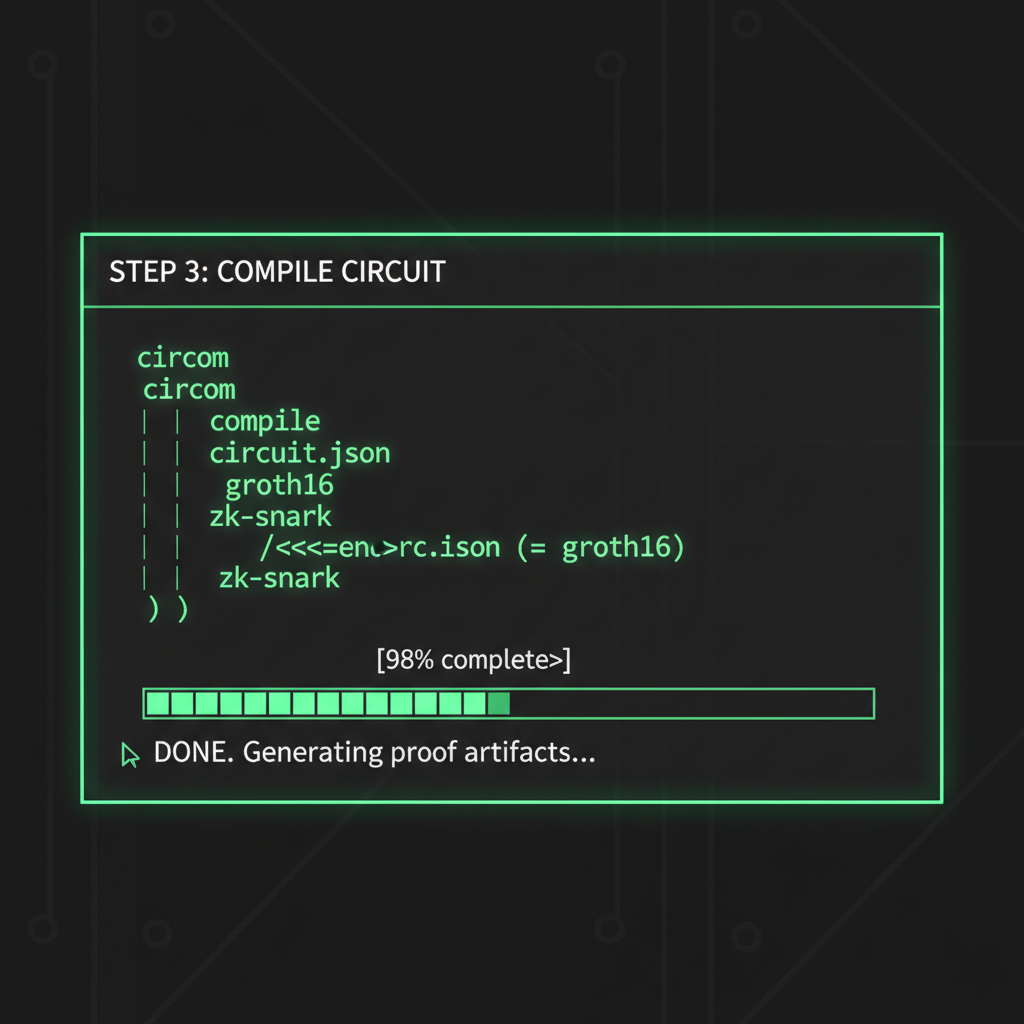
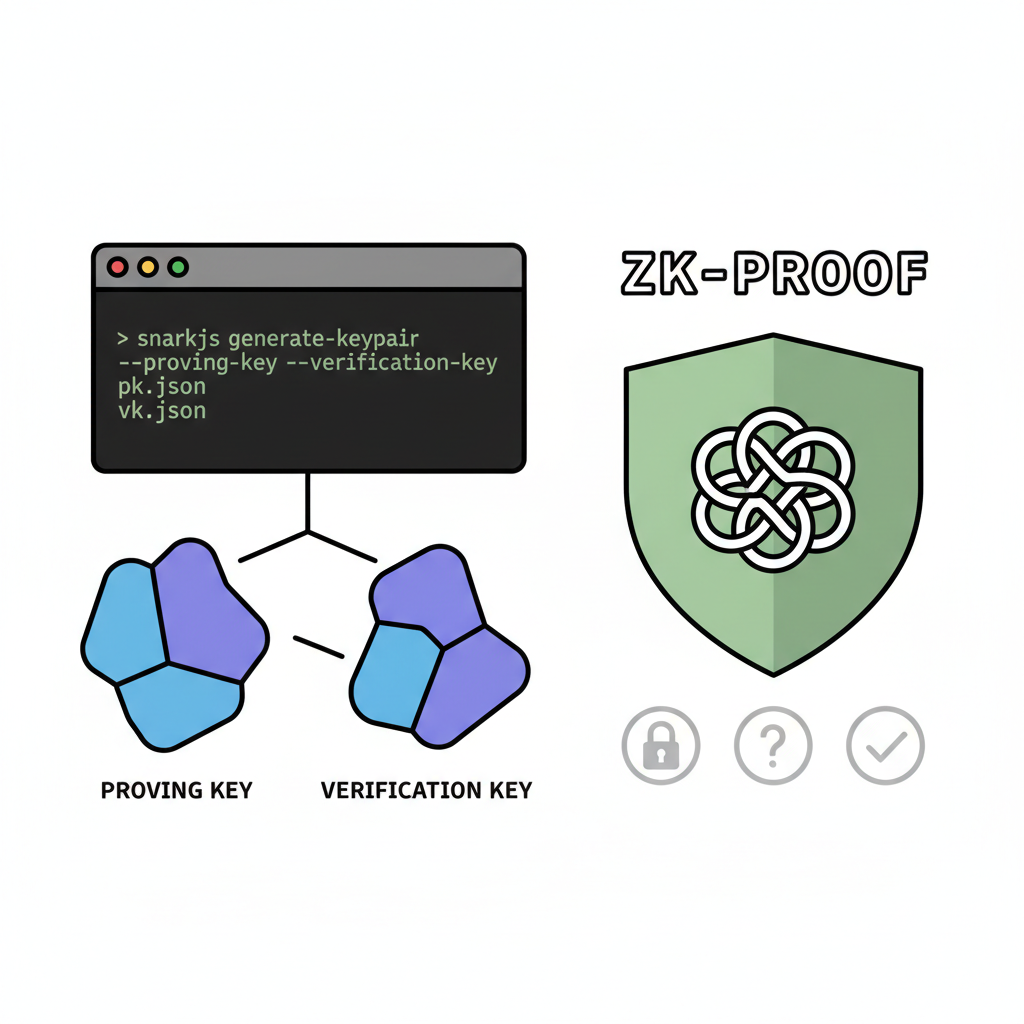
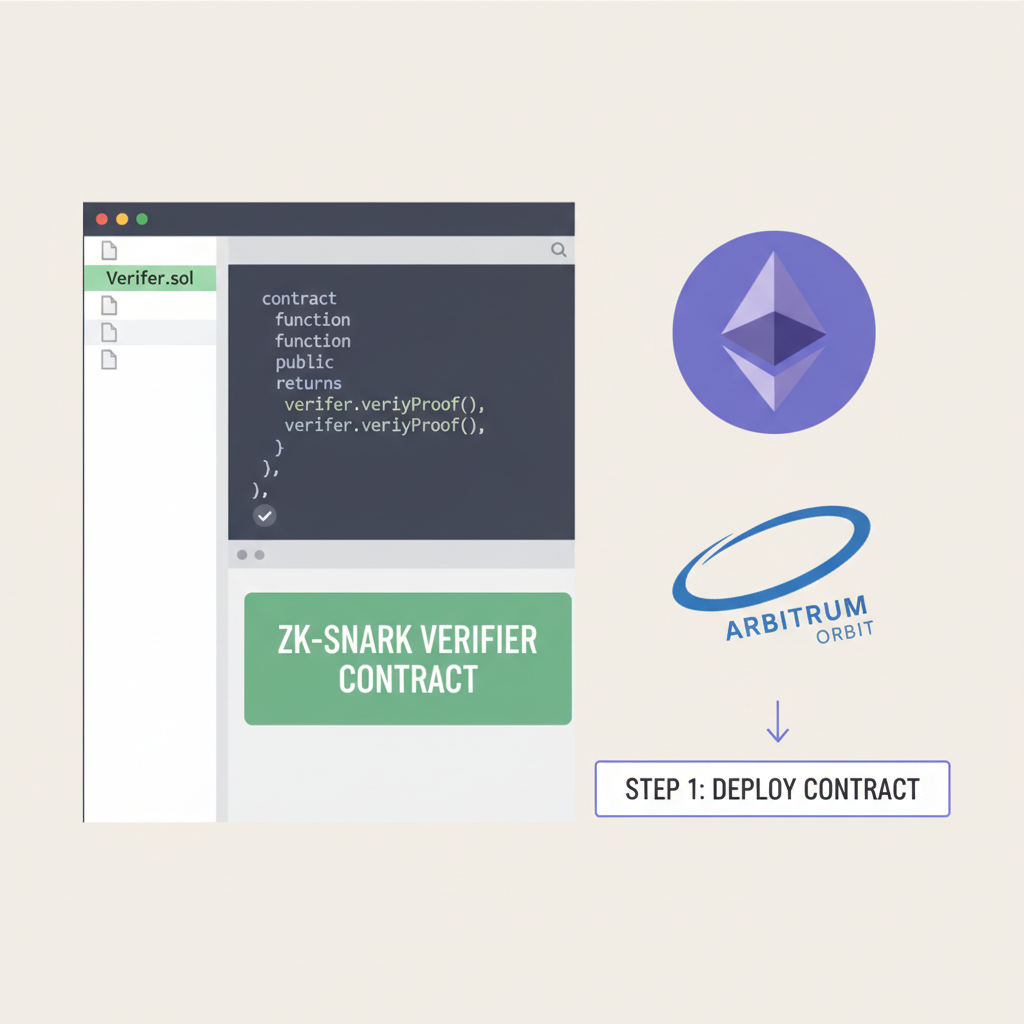
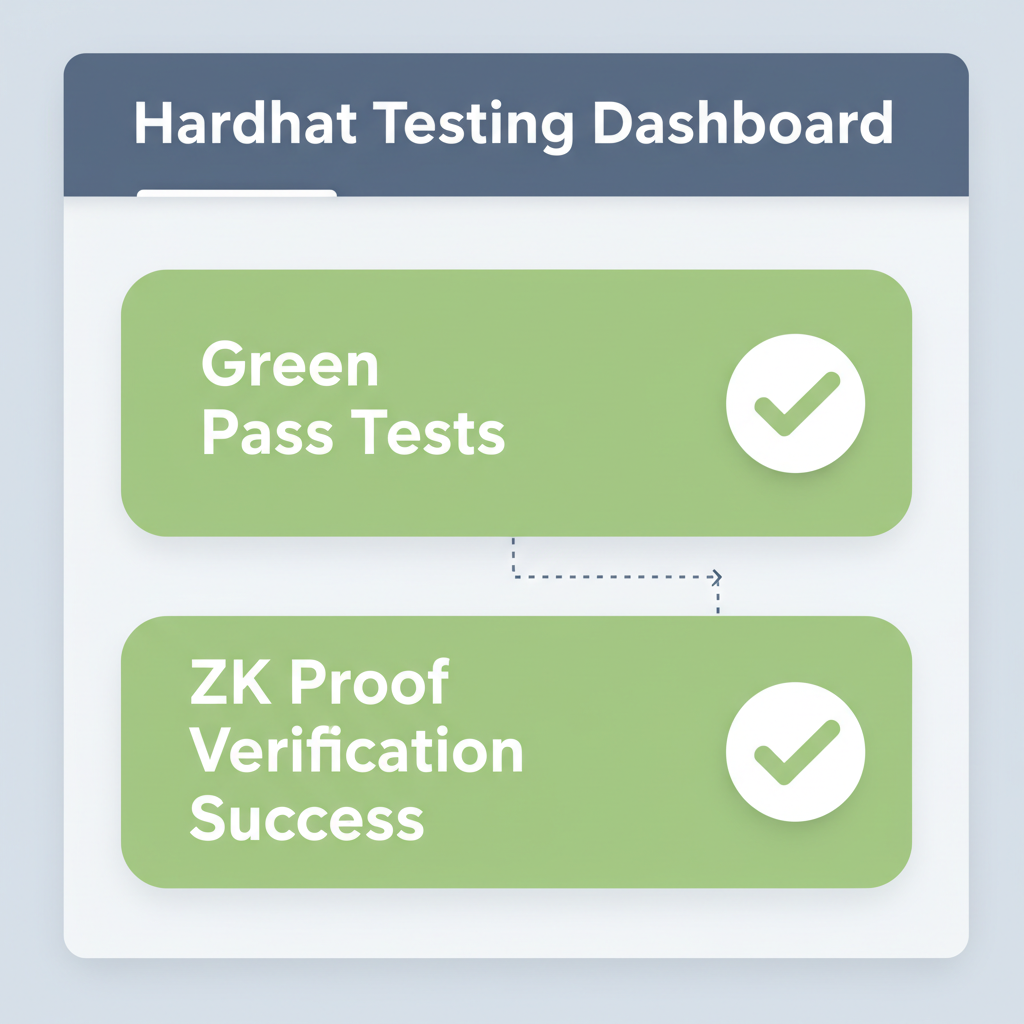
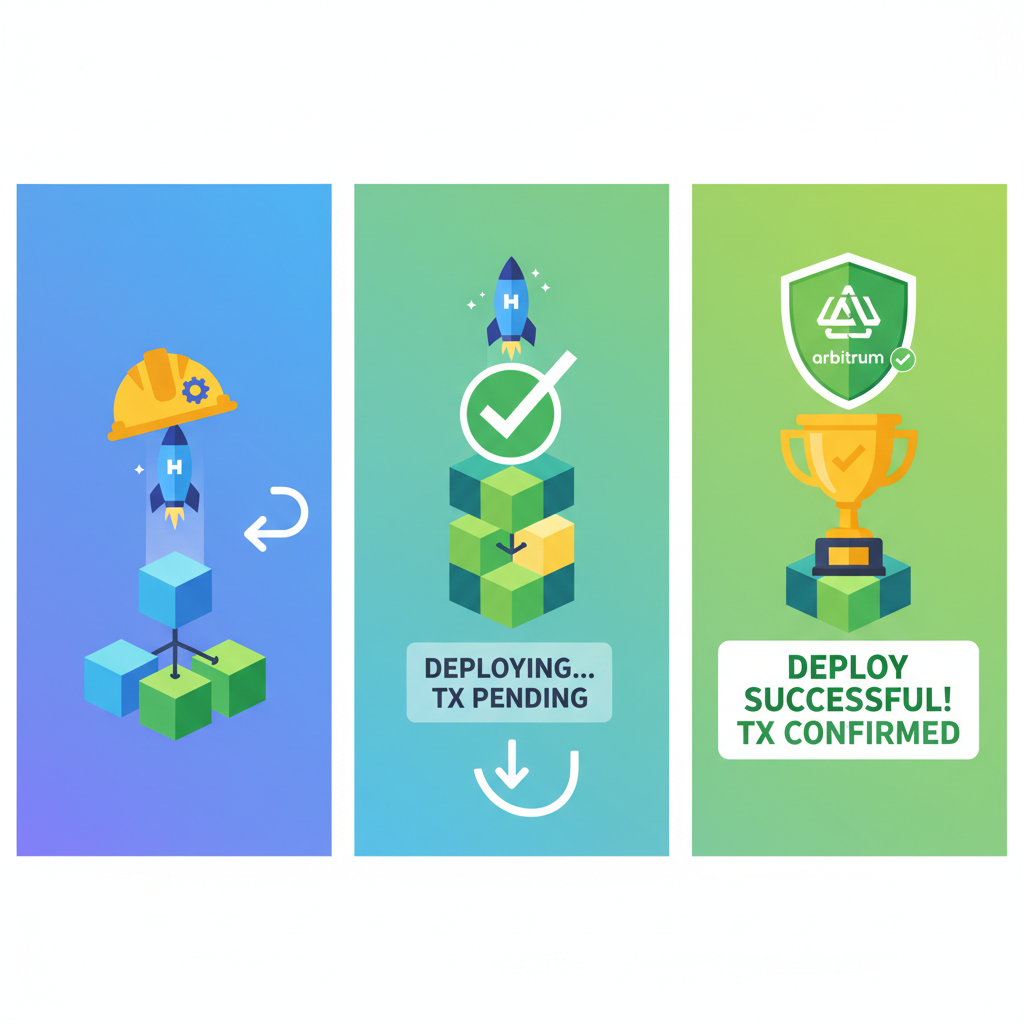
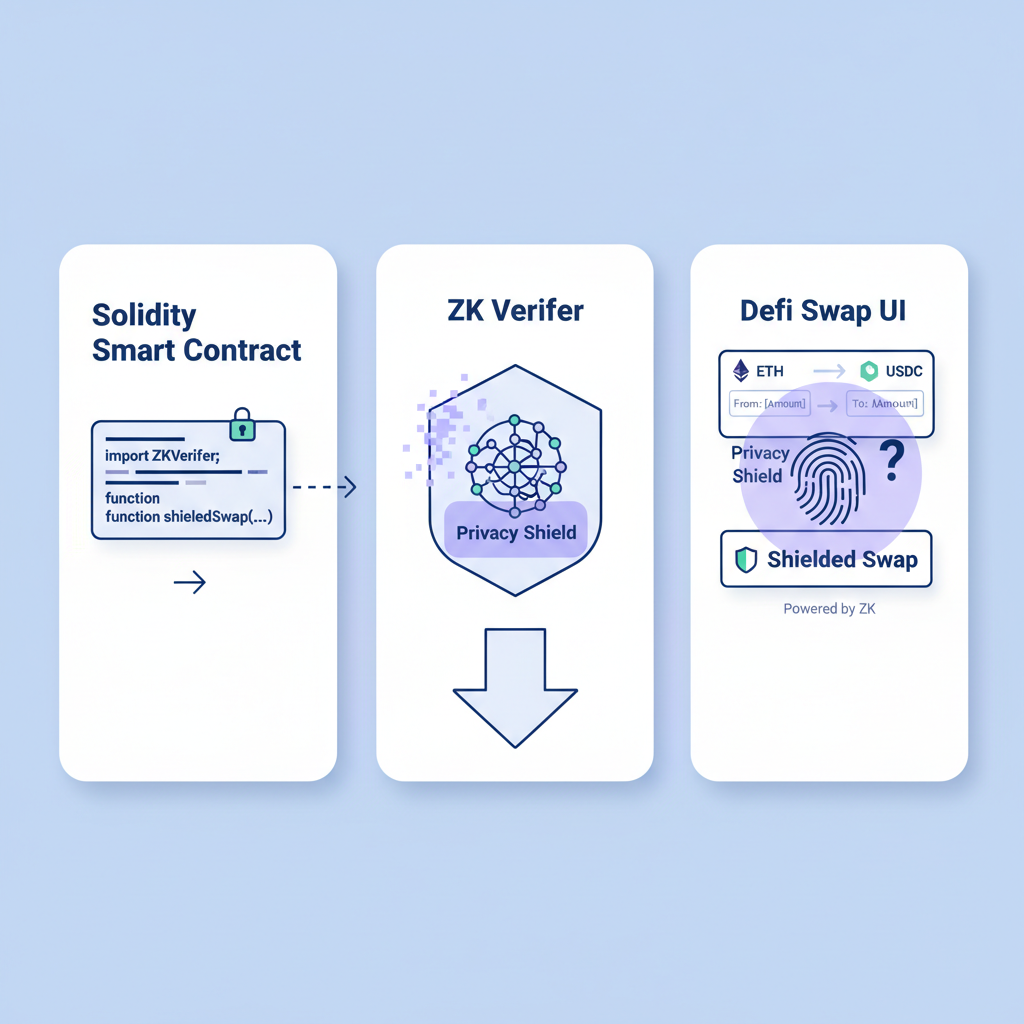
Arbitrum's RPC endpoints and Nitro's EVM parity make this plug-and-play. Start with a local Arbitrum node for testing, then bridge assets via official tools. The verifier contract exposes a public function: submit proof, public inputs like commitments, and trigger the swap if valid. Gas optimization reigns supreme; recursive SNARKs or STARK hybrids could aggregate proofs, slashing costs further for high-volume confidential token swaps on Arbitrum.
Testing demands rigor: simulate adversarial inputs, fuzz circuits, and leverage formal verification where possible. Arbitrum's Stylus upgrade beckons for Rust-based circuits, blending performance with safety. From my vantage as an investor eyeing FHE synergies, this L2 pivot fortifies DeFi against oracle manipulations and MEV, much like confidential computing stabilized commodities futures trading decades ago.
Navigating Challenges in Production
Computational overhead looms largest; proof times can spike under complex swaps. Counter with hardware acceleration via GPU provers or threshold schemes distributing load. Trusted setups? MPC ceremonies like those in Ethereum's DVT mitigate risks, paving transparent paths. Compliance weaves in via selective disclosure: zero-knowledge predicates prove attributes like 'amount under $10K' without unmasking.
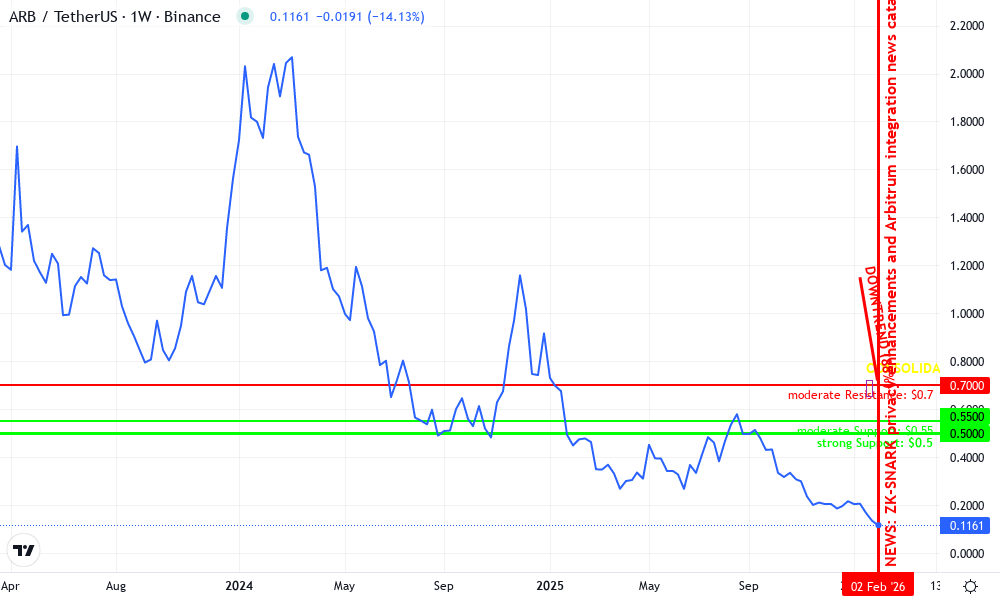
Arbitrum Technical Analysis Chart
Analysis by Liam Harper | Symbol: BINANCE:ARBUSDT | Interval: 1W | Drawings: 6
Technical Analysis Summary
Liam Harper here, conservative fundamental analyst. On this ARBUSDT 1D chart, illustrate the dominant downtrend with a thick red trend_line from the swing high on 2026-01-12 at 1.15 connecting to the recent lower high on 2026-02-03 at 0.72, projecting downside. Overlay horizontal_lines for key support at 0.50 (strong) and resistance at 0.70 (moderate). Rectangle the late-Jan consolidation between 0.65-0.72 from 2026-01-22 to 2026-02-01. Add arrow_mark_down on MACD bearish crossover around 2026-01-28, callout on declining volume, and text notes for ZK privacy catalyst potential.
Risk Assessment: medium
Analysis: Bearish technical structure tempers enthusiasm, but robust DeFi privacy fundamentals via ZK-SNARKs (Zswap, Ethereum L2 scalability) mitigate downside; low tolerance demands confirmation
Liam Harper's Recommendation: Conservatively accumulate on support dips for long-term hold, prioritizing LRT strategies over aggressive trades. Patience wins.
Key Support & Resistance Levels
📈 Support Levels:
-
$0.5 - Strong historical support zone tested multiple times, aligns with 2026 lows
strong -
$0.55 - Intermediate support from recent wicks
moderate
📉 Resistance Levels:
-
$0.7 - Recent swing high resistance, former consolidation top
moderate -
$0.85 - Approaching prior downtrend resistance
weak
Trading Zones (low risk tolerance)
🎯 Entry Zones:
-
$0.52 - Low-risk entry on support hold with volume pickup and ZK news alignment
low risk
🚪 Exit Zones:
-
$0.75 - Initial profit target at resistance retest
💰 profit target -
$0.48 - Tight stop below strong support to preserve capital
🛡️ stop loss
Technical Indicators Analysis
📊 Volume Analysis:
Pattern: declining
Volume drying up on downside moves, hinting at exhaustion and potential reversal setup for fundamentals
📈 MACD Analysis:
Signal: bearish
MACD histogram contracting below signal line, confirming momentum fade but watch for bullish divergence
Applied TradingView Drawing Utilities
This chart analysis utilizes the following professional drawing tools:
Disclaimer: This technical analysis by Liam Harper is for educational purposes only and should not be considered as financial advice.
Trading involves risk, and you should always do your own research before making investment decisions.
Past performance does not guarantee future results. The analysis reflects the author's personal methodology and risk tolerance (low).
Security audits are non-negotiable; engage firms versed in ZK primitives to probe soundness. Edge cases like griefing attacks or poisoned commitments demand custom mitigations. Yet, Arbitrum's fraud-proof window buys time for disputes, harmonizing optimism with zero-knowledge rigor.
Real-world pilots, akin to Zswap's multi-asset merges, hint at explosive adoption. Cross-chain bridges with privacy layers could unify liquidity pools, echoing global trade protocols where ZK proofs anonymize flows without halting oversight.
Future Horizons: ZK-Powered DeFi Maturity
Layer 2 synergies accelerate: Arbitrum's Orbit chains for custom privacy rollups, fused with FHE for on-chain computations over encrypted data. This convergence crafts macro-secure DeFi, resilient to regulatory tempests and quantum shadows. Developers prioritizing Arbitrum zk proofs DeFi today position for tomorrow's institutional inflows, where privacy isn't optional but foundational.
Patience defines winners here. As with historical shifts from open outcry pits to electronic confidential exchanges, ZK-SNARKs on Arbitrum herald enduring efficiency. Build now, and watch zero knowledge DeFi privacy redefine swaps from spectator sports to sovereign acts.