ZKP Privacy-First L1 Blockchain: Zero-Knowledge for Secure Web3 in 2026

In the evolving landscape of Web3, where data breaches and surveillance threats loom large, ZKP privacy-first L1 blockchains emerge as a beacon for secure, confidential transactions. As we stand on February 4,2026, with Ethereum trading at $2,252.41 after a slight 1.04% dip, the spotlight intensifies on projects like Zero Knowledge Proof (ZKP) Network. This Layer 1 chain, built from the ground up for privacy-protecting AI infrastructure, promises to redefine decentralized applications by embedding zero-knowledge proofs at its core.

Privacy ZK Layer1 solutions like ZKP address a critical gap: enabling computation on encrypted data without exposure. Unlike general-purpose chains struggling with scalability and confidentiality trade-offs, ZKP deploys real mining hardware called Proof Pods. These nodes perform intensive computing work, securing the network while generating proofs for AI workloads. With a live testnet already operational, ZKP demonstrates tangible progress amid hype.
ZKP’s $100 Million Infrastructure Foundation
Zero Knowledge Proof Network has invested $100 million in physical infrastructure before its presale even kicks into high gear. This includes deploying Proof Pods – specialized hardware that miners use to contribute computational power, earning tokens in return. It’s a novel twist on proof-of-work, tailored for ZK computations. Sources confirm over 1,000 closed testnet participants by mid-2025, scaling toward mainnet readiness. Yet, skeptics question the verifiability of these claims, urging due diligence on unproven capital raises.
This pre-presale buildout sets ZKP apart from vaporware projects. In a market where Monero holds steady at $388.55 with a 1.53% gain and Zcash dips to $278.92, ZKP positions itself as the next evolution: a full-fledged zero-knowledge L1 for AI privacy. Proof Pods incentivize hardware involvement, democratizing access to high-end ZK proving while bolstering network security.
Presale Auction: Fair Distribution Meets Scarcity
ZKP’s 450-day rolling presale auction enforces $50K daily caps, fostering equitable token distribution. Deflationary burns amplify scarcity, potentially driving value as demand builds toward a $1.7 billion fundraising goal. This model rewards early hardware contributors and aligns incentives for long-term holders. Compared to Ethereum’s privacy roadmap – accelerating ZK proofs for everyday devices – ZKP leapfrogs with dedicated L1 primitives.
Institutional tailwinds add momentum. The GENIUS Act of 2025 mandates privacy-preserving finance, while Paxos-Aleo’s USAD stablecoin showcases ZKP for encrypted wallets. Zcash’s Tachyon upgrade cuts ZK costs for shielded txs, and Monero’s FCMP and and introduces selective disclosure, but neither matches ZKP’s AI-centric vision.
Proof of Intelligence and Roadmap Milestones
At ZKP’s heart lies Proof of Intelligence (PoI) and Proof of Space (PoSp), blending ZK circuits optimized for AI ops. The 2025-2029 roadmap charts specialized circuits by 2026, mainnet launch, and ecosystem expansion through 2029. This targets privacy-preserving machine learning on-chain, vital for DeFi and enterprise apps.
ZKP Price Prediction 2027-2032
Forecast based on mainnet launch, privacy adoption, $1.7B presale potential, and Web3 trends (from 2026 baseline of $0.50 post-presale)
| Year | Minimum Price | Average Price | Maximum Price |
|---|---|---|---|
| 2027 | $2.50 | $5.00 | $10.00 |
| 2028 | $4.00 | $12.00 | $25.00 |
| 2029 | $10.00 | $35.00 | $60.00 |
| 2030 | $20.00 | $55.00 | $100.00 |
| 2031 | $30.00 | $85.00 | $160.00 |
| 2032 | $45.00 | $130.00 | $250.00 |
Price Prediction Summary
ZKP is projected to experience explosive growth post-mainnet in 2027, driven by privacy-first L1 innovations and AI infrastructure, with average prices climbing from $5 in 2027 to $130 by 2032 amid bullish adoption; min/max reflect bearish cycles and hyper-growth scenarios.
Key Factors Affecting ZKP Price
- Mainnet launch and Proof Pods scaling in 2027 boosting utility
- $1.7B presale raise and deflationary tokenomics enhancing scarcity
- Institutional adoption via privacy regulations like GENIUS Act
- Ethereum privacy upgrades and competition from Zcash/Monero
- Market cycles with 2028 bull potential post-BTC halving
- AI-Web3 integration and ZKP circuit advancements for scalability
Disclaimer: Cryptocurrency price predictions are speculative and based on current market analysis.
Actual prices may vary significantly due to market volatility, regulatory changes, and other factors.
Always do your own research before making investment decisions.
Balancing innovation with risk, ZKP’s trajectory hinges on delivering verifiable tech amid bold projections. For risk-optimized portfolios, it offers medium-term upside in ZKP presale Web3 plays, but demands scrutiny of Proof Pods’ real-world efficacy. Ethereum’s $2,252.41 price underscores L1 stability, yet privacy premiums favor secure ZK chains like ZKP.
Privacy isn’t optional in 2026 Web3 – it’s the foundation for trustless scaling.
That foundation demands rigorous validation, especially as privacy coins navigate choppy waters. Monero’s $388.55 price reflects resilience with its 1.53% uptick, bolstered by FCMP and and upgrades for selective disclosure. Zcash, at $278.92, grapples with a 1.26% decline despite Tachyon’s promise to slash ZKP costs for shielded transactions. Ethereum’s steady $2,252.41 amid L1 scaling efforts highlights the need for specialized chains like ZKP to carve out privacy premiums.
Navigating Risks in ZKP’s Ambitious Vision
Skepticism lingers around ZKP’s bold claims – $100 million in infrastructure and a $1.7 billion presale target without ironclad proof. Critics rightly probe the opacity of Proof Pods’ deployment and PoI’s real-world efficiency. In my view, this mirrors early DeFi hype cycles: innovation accelerates, but unverified hardware risks network centralization if pod distribution skews. Yet, the daily $50K auction caps and burns offer a counterbalance, enforcing scarcity without whale dominance. For secure ZK chain enthusiasts, ZKP’s testnet traction – with over 1,000 participants – signals legitimacy, but mainnet proofs will be the litmus test.
Proof Pods stand out as a pragmatic evolution, turning mining rigs into ZK accelerators. This hardware-software synergy could outpace software-only provers, especially for AI inference under encryption. Pair it with Ethereum’s privacy RPCs, and you get a interoperable Web3 stack where ZKP handles heavy privacy lifts.
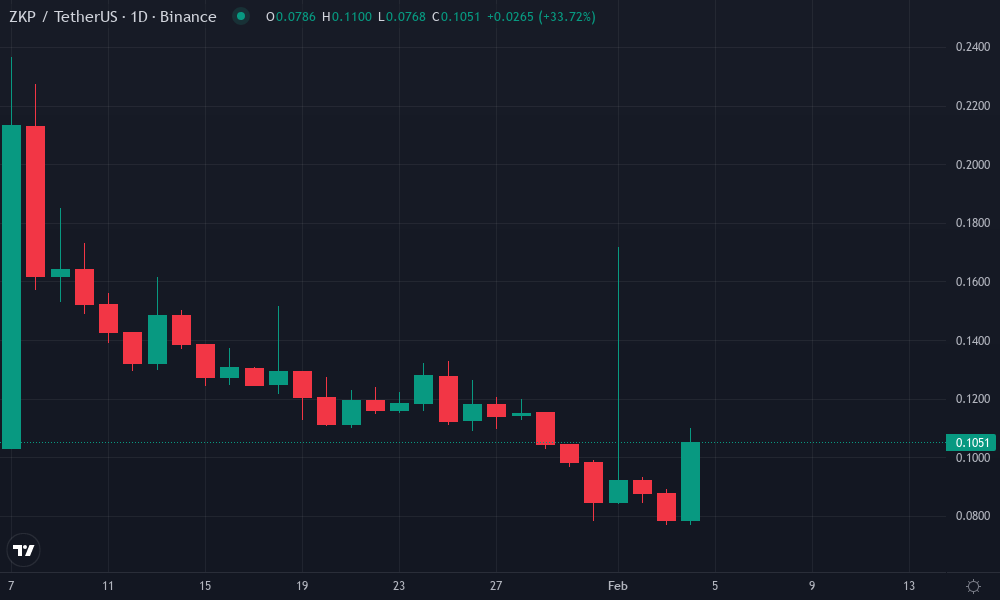
ZKP Technical Analysis Chart
Analysis by Market Analyst | Symbol: BINANCE:ZKPUSDT | Interval: 1D | Drawings: 5
Technical Analysis Summary
To annotate this ZKPUSDT 1H chart effectively in my balanced technical style, start by drawing a primary downtrend line connecting the swing highs from 2026-02-01 high at 0.0058 to the 2026-02-07 high at 0.0032, extending to current levels around 0.0018. Add horizontal support at 0.0015 (recent lows) and resistance at 0.0025 (prior consolidation base). Mark a recent consolidation rectangle from 2026-02-08 to 2026-02-10 between 0.0018-0.0022. Use arrow_mark_down for the breakdown on high volume around 2026-02-04. Place callouts on volume spikes noting ‘distribution’ and MACD histogram for bearish divergence. Fib retracement from recent low 0.0015 to high 0.0022 for potential pullback targets. Long position marker at 0.0016 entry with stop below 0.0014 and profit at 0.0025.
Risk Assessment: medium
Analysis: Downtrend intact but oversold with volume exhaustion; privacy sector tailwinds add upside potential but presale hype fade risks further drop
Market Analyst’s Recommendation: Wait for close above 0.0020 for longs, target 0.0032; medium risk tolerance favors scaled entries here
Key Support & Resistance Levels
📈 Support Levels:
-
$0.002 – Strong volume shelf at recent lows, aligns with chart bottom
strong -
$0.001 – Psychological extension below current, untested
weak
📉 Resistance Levels:
-
$0.003 – Prior swing low turned resistance from mid-Feb consolidation
moderate -
$0.003 – Key Feb high, major hurdle for bullish reversal
strong
Trading Zones (medium risk tolerance)
🎯 Entry Zones:
-
$0.002 – Bounce from strong support with volume pickup, low-risk long setup
low risk -
$0.002 – Break above resistance confirmation, medium risk add
medium risk
🚪 Exit Zones:
-
$0.001 – Below support invalidates bounce
🛡️ stop loss -
$0.003 – First resistance target
💰 profit target -
$0.003 – Extended target on breakout
💰 profit target
Technical Indicators Analysis
📊 Volume Analysis:
Pattern: Climax selling volume on breakdowns, drying up on bounce
Bearish but potential exhaustion signal as volume decreases on recent lows
📈 MACD Analysis:
Signal: Bearish crossover with histogram divergence
MACD line below signal, but histogram flattening suggests weakening momentum
Applied TradingView Drawing Utilities
This chart analysis utilizes the following professional drawing tools:
Disclaimer: This technical analysis by Market Analyst is for educational purposes only and should not be considered as financial advice.
Trading involves risk, and you should always do your own research before making investment decisions.
Past performance does not guarantee future results. The analysis reflects the author’s personal methodology and risk tolerance (medium).
Privacy ZK Layer1 Meets Institutional Demands
Regulatory shifts amplify ZKP’s edge. The GENIUS Act enforces privacy infrastructure, paving the way for ZKP-driven coins in compliant finance. Paxos-Aleo’s USAD stablecoin exemplifies this, masking addresses and amounts via ZK – a blueprint for ZKP’s AI extensions. As institutions rotate into privacy assets, ZKP’s zero-knowledge L1 could capture flows shunned by transparent chains. Learn more on how zero-knowledge proofs turbocharge scalability without sacrificing privacy at zktoday.com.
From a portfolio lens, blending ZKP presale exposure with stalwarts like Monero offers balanced upside. Its AI focus aligns with 2026 trends: on-chain models demanding confidentiality. Risks? Execution delays or proof verification bottlenecks. Rewards? If Proof Pods scale, ZKP could redefine ZKP L1 blockchain viability, yielding asymmetric returns in a $2,252.41 Ethereum backdrop.
Developers eyeing encrypted smart contracts will find ZKP’s primitives invaluable, accelerating from testnet experiments to production. As FHE matures alongside ZK, hybrids like ZKP’s PoI could enable full homomorphic ops on proofs, unlocking private DeFi oracles. This isn’t mere speculation; it’s the logical pivot for Web3 maturity.
Stakeholders should monitor pod adoption metrics and auction velocity closely. In a landscape favoring verifiable privacy, ZKP’s hardware commitment positions it to lead, bridging AI’s compute hunger with blockchain’s trust vacuum. Balance the hype with on-chain diligence, and 2026’s secure Web3 unfolds through chains like this.